Why 23 people are enough for a shared birthday: counting pairs, not people
30seconds
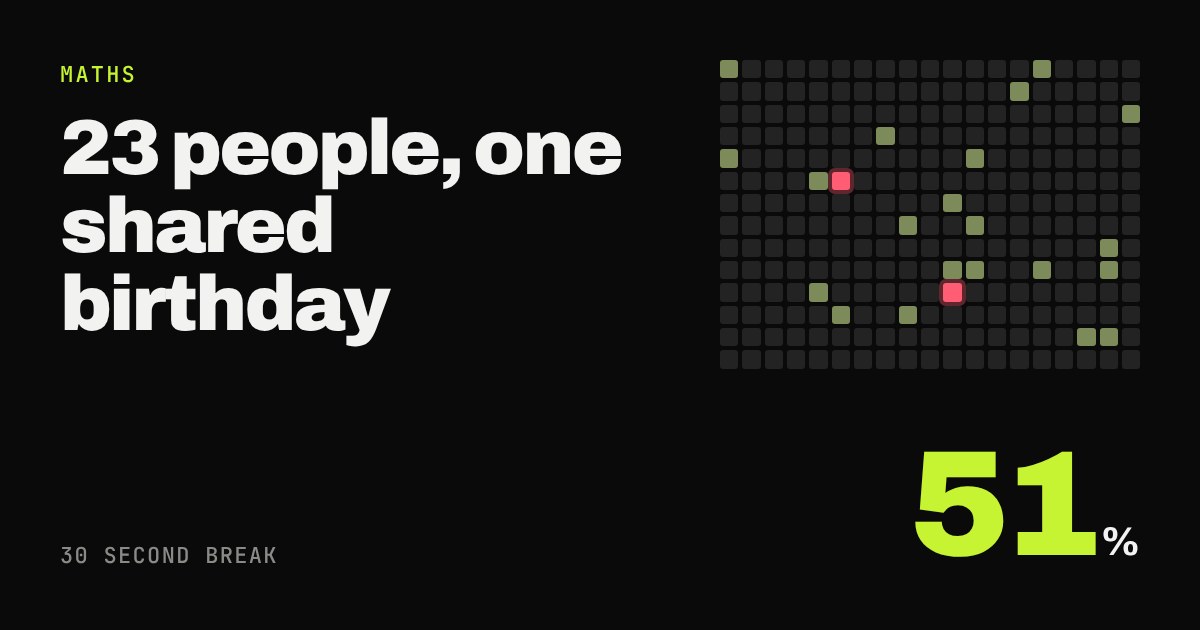
Put 23 people in a room and the chance that two share a birthday is already 51%. It feels far too low a number, because we picture one person matching our birthday. The real question is whether any two match, and that is about pairs. 23 people make 253 pairs, and every pair is another small chance.
Fill a year of 365 squares with random birthdays, slide the room size up and down, and watch the pink collisions appear. Then run 1,000 rooms to see the tally settle on the maths.
Deep dive · 3 min
More in Maths
View all →
Why random bounces pile up into a bell curve: the Galton board
Every ball in a Galton board makes the same blind choice at each peg: left or right, a coin flip. Yet drop enough of them and the pile always grows into the…
Why switching doors wins twice as often: the Monty Hall problem
Three doors, one car. You pick one, the host opens a goat door, and offers a swap. Most people say it's 50/50. It isn't: switching wins twice as often as…
Why 1 leads far more often than 9: Benford's law of first digits
Look only at the first digit of any long list of real-world numbers, such as river areas, populations or the figures in a company's accounts. You'd expect each…
How dropping needles on a floor reveals the number π: Buffon's needle
Toss a match onto a plank floor and ask: does it touch a crack? Do it thousands of times and the fraction that do will quietly spell out π, though no circle is…
Why 23 people are enough for two to share a birthday
Put 23 people in a room and there's a better-than-even chance that two of them share a birthday. That sounds wrong, because 23 is tiny next to 365. The catch…
Why turning a wobbly table can stop it rocking: the quarter-turn proof
Your café table rocks. Before you wedge a folded napkin under a leg, try turning the whole table on the spot. On most floors, somewhere within a quarter-turn…