Why a boat's wake is always a 39° V: Kelvin's wedge
30seconds
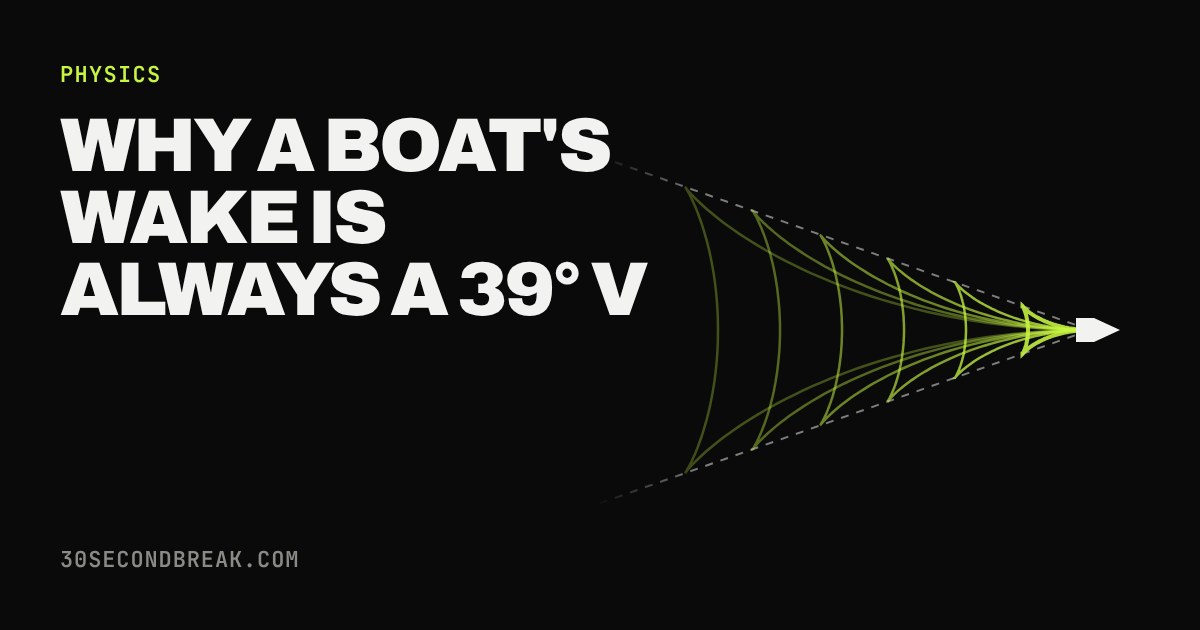
Behind every boat spreads a V of ripples, and it is always about 39° wide, whether the boat crawls or speeds. Lord Kelvin worked out why in 1887: only waves that keep pace with the boat add up, and deep-water waves carry energy at half their phase speed, which pins the edge at arcsin(1/3), about 19.47° either side.
Build the wake yourself, drag the wave direction to see why nothing ever goes wider, then switch to sound-like waves and watch a jet-style cone narrow with speed instead.
Deep dive · 4 min
More in Physics
View all →
Why the bottom of a dropped Slinky hangs in mid-air: a wave has to bring the news
Hold a Slinky by its top, let it stretch, and let go. The top rushes down while the bottom coil hovers, apparently ignoring gravity, until the collapsing coils…
Why a dried coffee drop leaves a ring: the edge is stuck and the rim dries first
Spill coffee, let it dry, and you get a dark ring with a pale middle, not an even stain. The pigment started out spread through the whole drop. The drop's edge…
Why a tossed tennis racket flips: the intermediate axis theorem
Spin a tennis racket about its handle or its face and it flies cleanly. Spin it about the third axis and it flips, even in orbit where nothing pushes on it…
Why water drops last longer on a hotter pan: the Leidenfrost effect
Flick water onto a warm pan and it sizzles away in a second. Make the pan hotter, past about 193 °C, and something odd happens: the drop pulls into a bead…
Why soap bubbles swirl with colour, then turn black just before they pop
Soap has no dye, yet bubbles shimmer with magenta, gold and green. The colour comes from thickness: light bounces off both the front and the back of the film…
Why the sky is blue and sunsets are red: it's the same light
The blue sky and the red sunset are the same effect, seen from two angles. Air molecules scatter short, blue wavelengths far more than long, red ones: about…