Why sorting gets slow so fast: bubble sort versus merge sort and n log n
30seconds
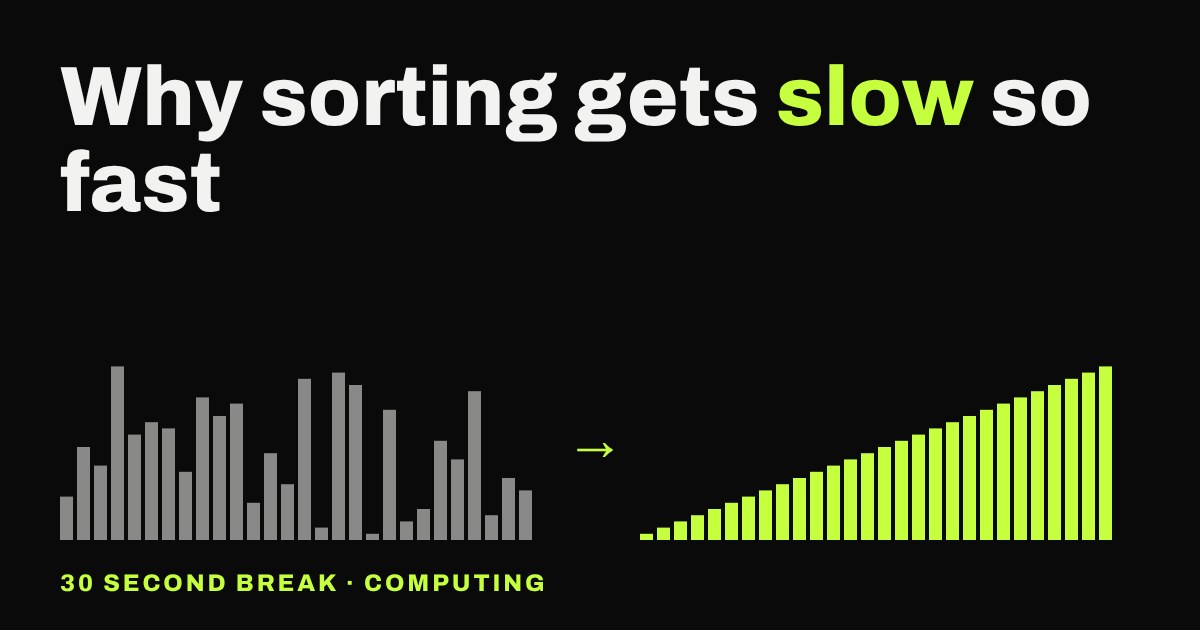
Two sorting methods can both be perfectly correct and still differ by a factor of 25,000 on a big list.
Race bubble sort against merge sort on the same shuffled bars, watch the comparison counters, then slide the list size up to a billion and see why doubling the input can quadruple the work for one method and barely more than double it for the other.
Deep dive · 3 min
More in Computing
View all →
How your phone finds the quickest route: Dijkstra's shortest-path algorithm
Your phone finds the fastest route across millions of roads without trying them all. The trick is a rule Edsger Dijkstra devised in 1956: always finish the…
Why eight yes/no answers can draw a fractal, make noise or compute: elementary cellular automata
Take a row of lit and dark squares and repeat one tiny rule to make the next row: look at a square and its two neighbours, then decide if it is lit. There are…
Why one flipped bit can be found and fixed: Hamming's error-correcting code
A single flipped bit can turn a good file into garbage, yet a machine can find and repair it without ever seeing the original. In 1950 Richard Hamming, tired…
Why swapping cards at random is not a fair shuffle: Fisher–Yates and the 27 paths
Shuffling three cards by swapping each one with a random card from the whole row looks fair, but it is not. It makes 3 × 3 × 3 = 27 equally likely paths for…
How to find one name among a billion in 30 looks: binary search
Pick a number from 1 to 1,000,000 and you can find it in at most 20 yes-or-no questions. The trick is binary search: look in the middle of a sorted list, throw…
Why common letters get short codes in a ZIP file: Huffman coding
ASCII spends 8 bits on every letter, whether it is a common e or a rare z. In 1951 a graduate student, David Huffman, found a way to give frequent symbols…