How thousands of fireflies flash in time with no leader: pulse-coupled oscillators
30seconds
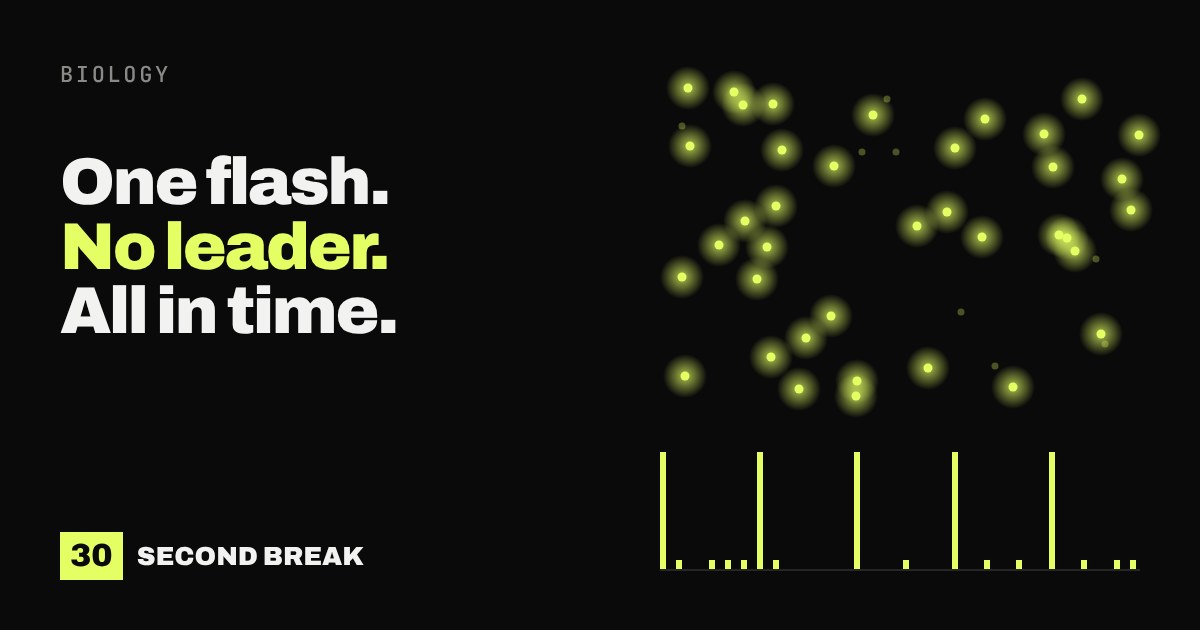
On riverbank trees in Southeast Asia, thousands of male fireflies flash together, with no leader and no shared clock. Each insect is just a small timer that nudges itself toward any flash it sees.
Scatter a meadow of simulated fireflies, then slide the strength of their reaction and the size of the crowd. Tap the field to wave a lantern and watch the chart of flashes turn into tall, narrow spikes as the rhythm takes over.
More in Biology
View all →
Why nearly every species makes sons and daughters in equal numbers: Fisher's grandchildren argument
Boys and girls are born in nearly equal numbers, about 105 boys for every 100 girls worldwide, even though one male could father far more children than one…
Why an elephant doesn't eat 200,000 times more than a mouse: Kleiber's three-quarter law
A mouse is 200,000 times lighter than an elephant, yet the elephant burns only about 9,000 times more energy. In 1932 Max Kleiber found that resting metabolic…
Why a nerve spike is always the same size: the all-or-nothing action potential
Every nerve signal in your body is the same size. A feather touch and a hammer blow send identical electrical spikes, so how does the brain tell them apart?…
Why predators boom after the prey do: Lotka–Volterra and the Adriatic fish puzzle
After the First World War, an Italian biologist noticed something odd in Adriatic fish catches: with less fishing, the share of predators had gone up, not…
Why a smooth embryo grows spots and stripes: Turing's two-chemical patterns
A leopard's spots and a zebra's stripes start from a smooth, featureless ball of cells. In 1952 Alan Turing showed how two chemicals that spread at different…
Why cells stay tiny: skin grows with the square, the cell with the cube
Double a cell's width and its skin grows 4 times, but the cytoplasm it must feed grows 8 times. Add diffusion, where time grows with the square of the…