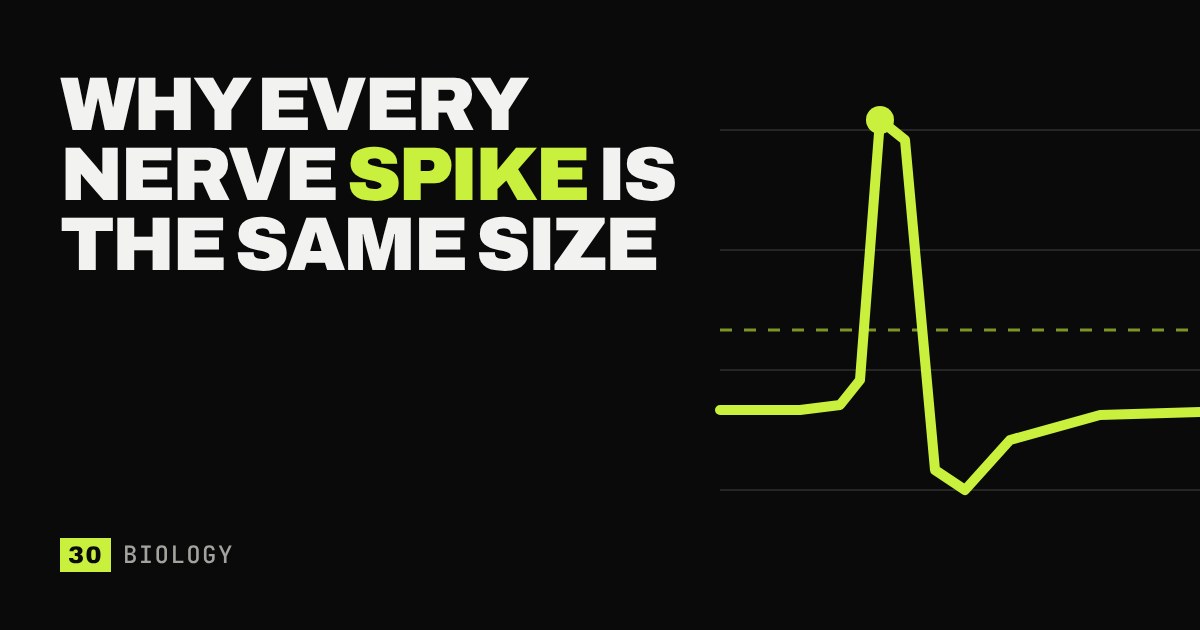
Why a nerve spike is always the same size: the all-or-nothing action potential
30seconds
Every nerve signal in your body is the same size. A feather touch and a hammer blow send identical electrical spikes, so how does the brain tell them apart?
Drive a live Hodgkin–Huxley neuron: zap it weakly and nothing is passed on, zap it past the threshold and it fires a full spike. Push harder and the spikes come faster, not taller. Then switch off the sodium channels, as pufferfish toxin does.
Deep dive · 4 min
More in Biology
View all →
Why predators boom after the prey do: Lotka–Volterra and the Adriatic fish puzzle
After the First World War, an Italian biologist noticed something odd in Adriatic fish catches: with less fishing, the share of predators had gone up, not…
Why a smooth embryo grows spots and stripes: Turing's two-chemical patterns
A leopard's spots and a zebra's stripes start from a smooth, featureless ball of cells. In 1952 Alan Turing showed how two chemicals that spread at different…
Why cells stay tiny: skin grows with the square, the cell with the cube
Double a cell's width and its skin grows 4 times, but the cytoplasm it must feed grows 8 times. Add diffusion, where time grows with the square of the…
Why a gene can vanish by pure luck: genetic drift
Two versions of a gene start at 50% each. Neither is better, yet in a small population one will vanish by pure chance and the other will take over. This is…
How thousands of fireflies flash in time with no leader: pulse-coupled oscillators
On riverbank trees in Southeast Asia, thousands of male fireflies flash together, with no leader and no shared clock. Each insect is just a small timer that…
Why fishing less gave the Adriatic more sharks: foxes, rabbits and a loop
When fishing slowed during the First World War, the Adriatic catch held a bigger share of sharks and rays, not a smaller one. Mathematician Vito Volterra…