How two royal names in rings cracked hieroglyphs: Ptolemy, Cleopatra and the Rosetta Stone
30seconds
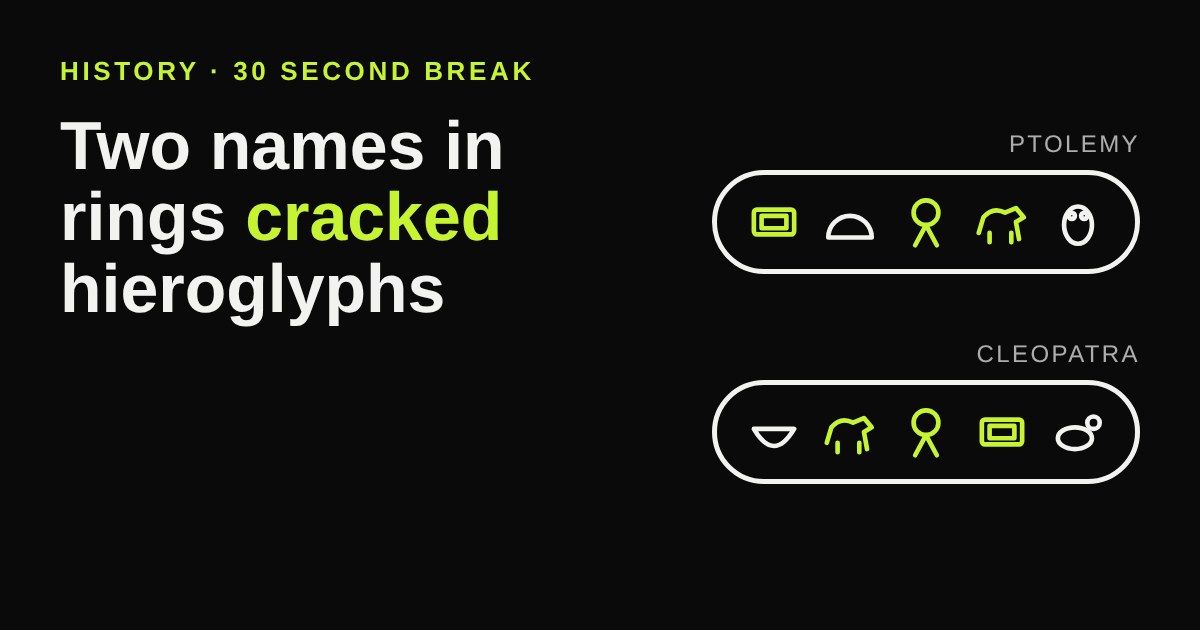
In 1799 a slab was dug up near Rosetta carrying one decree in three scripts, and nobody could read two of them. The first foothold was tiny: royal names sealed inside oval rings called cartouches.
Two names that share letters make a built-in check, because a sign appearing in both must carry the same sound. Read Ptolemy's ring, then use those signs to unlock Cleopatra's, as Champollion did on the road to 1822.
Deep dive · 4 min
More in History
View all →
How a stick's shadow measured the whole Earth: Eratosthenes, a well and 5,000 stadia
Two sticks, one shadow and one distance were enough for Eratosthenes to size the whole planet around 240 BC. On the summer solstice the noon Sun shone straight…
How a clock found longitude at sea: Harrison's H4 and the £20,000 prize
In 1707 a British fleet hit the rocks off Scilly because navigators could not find longitude. Seven years later Parliament offered £20,000 for a method…
How a map of dots found a cholera pump in 1854: John Snow and Broad Street
In late August 1854, cholera tore through a few streets of Soho, killing roughly 600 people in weeks. Almost everyone blamed foul air. John Snow suspected the…
How a beam with no date gets one: tree rings and crossdating
A beam from a ruined house has no date on it, but its rings do. Trees from the same region share the same wide and thin years, so a pattern of ring widths can…
How a stick and a well measured the whole Earth: Eratosthenes
Around 240 BC, the librarian Eratosthenes measured the size of the Earth using a well, a stick and a shadow. At noon on the summer solstice the sun shone…
Why washing hands saved mothers in 1847: Semmelweis and the two wards
In 1846, mothers in one Vienna maternity ward died at four times the rate of mothers in the ward next door. The doctors' ward was losing 11.4% of its patients…