Why sunflower seeds never leave gaps: the golden angle and the Fibonacci spirals
30seconds
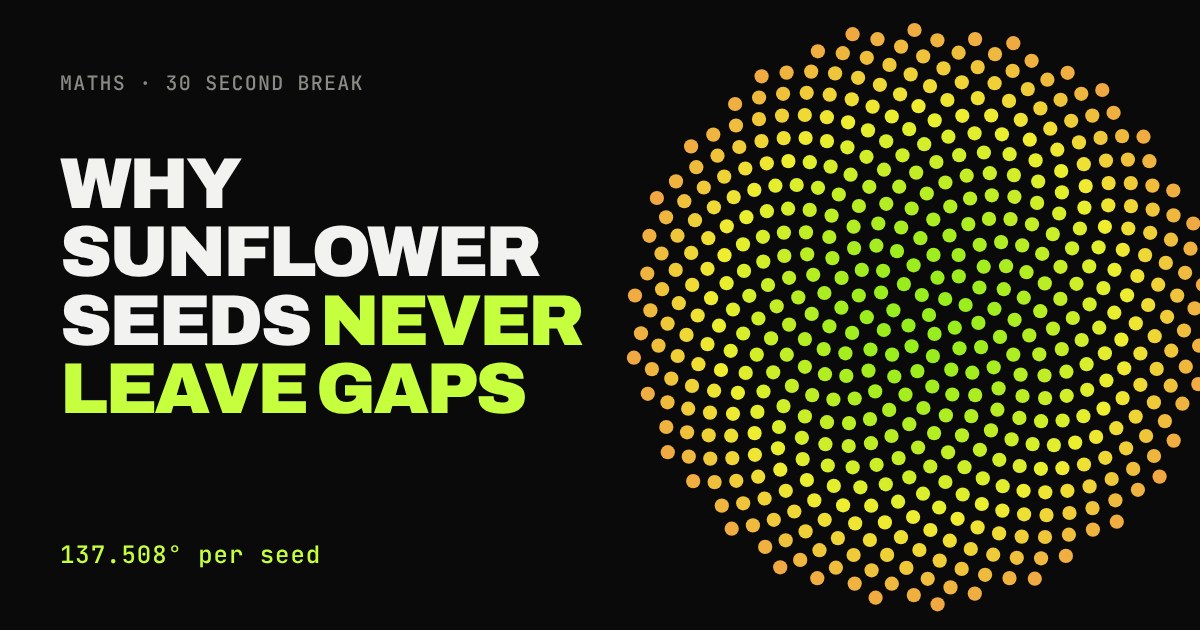
Sunflower seeds are not placed in spirals on purpose. Each new seed turns a fixed angle from the last, and only one angle, about 137.5 degrees, leaves no bare lanes.
Drag the angle yourself: any simple fraction of a turn piles seeds into straight arms, and even a fifth of a degree off the golden angle opens gaps. The famous Fibonacci spiral counts, like 34 and 55, are just that angle's near-returns showing up.
Deep dive · 4 min
More in Maths
View all →
Why random dice rolls draw a perfect fractal: the chaos game and the Sierpiński triangle
Pick three dots, then keep jumping halfway towards a randomly chosen one. It sounds like it should leave a grey smudge, but after a few thousand jumps a…
Why a dropped stick can find π: Buffon's needle
Drop a stick on a floor of planks and count how often it lands across a seam. The count secretly contains π: for a needle as long as the plank width, the…
Why 23 people are enough for a shared birthday: counting pairs, not people
Put 23 people in a room and the chance that two share a birthday is already 51%. It feels far too low a number, because we picture one person matching our…
Why random bounces pile up into a bell curve: the Galton board
Every ball in a Galton board makes the same blind choice at each peg: left or right, a coin flip. Yet drop enough of them and the pile always grows into the…
Why switching doors wins twice as often: the Monty Hall problem
Three doors, one car. You pick one, the host opens a goat door, and offers a swap. Most people say it's 50/50. It isn't: switching wins twice as often as…
Why 1 leads far more often than 9: Benford's law of first digits
Look only at the first digit of any long list of real-world numbers, such as river areas, populations or the figures in a company's accounts. You'd expect each…