Why a bridge needs gaps: steel grows when it warms, and a locked beam pushes back
30seconds
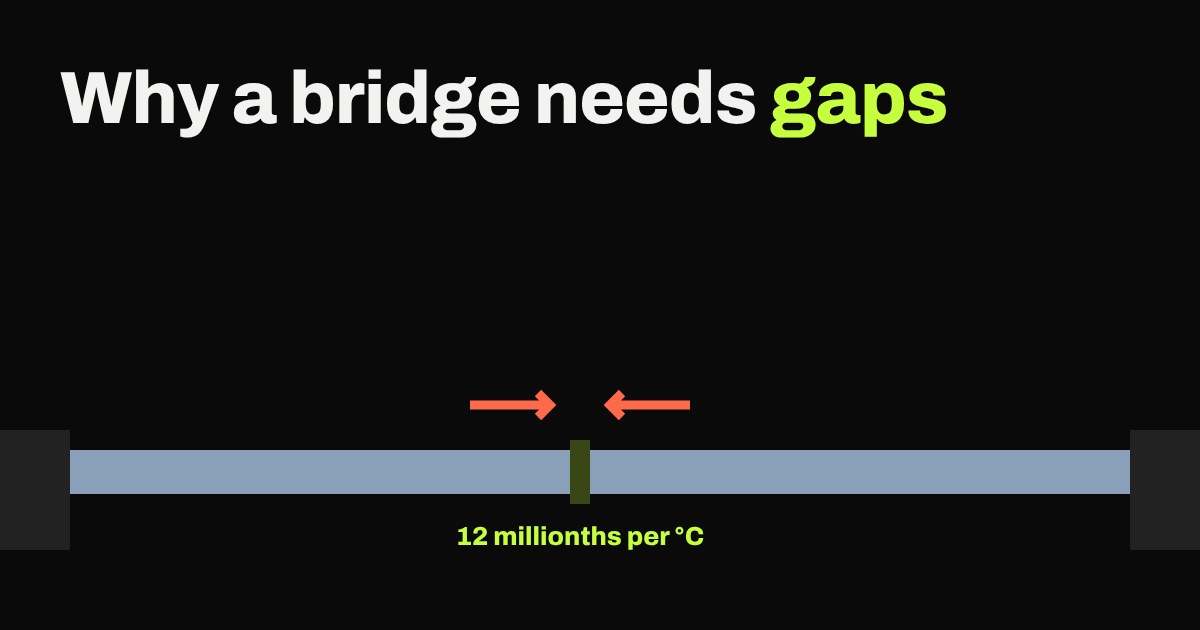
Steel grows about 12 millionths of its length for every degree it warms, so a 1 km rail swells by roughly half a metre on a hot day. Bridges let it move with expansion joints, and modern railways weld the rails and hold them down instead.
Lock a beam so it cannot grow and the growth turns into force: about 2.4 MPa of squeeze for every degree, about 100 tonnes on each wall of a thick beam after a 40 °C rise.
Slide the temperature, lock the beam and heat a rail until it kinks.
Deep dive · 4 min
More in Engineering
View all →
Why a low gear climbs hills: gear ratios trade speed for force
Pedal up a steep hill in the same gear you use on the flat and the pedals feel like concrete. Click to an easy gear and the climb gets bearable, but your feet…
Why a ship rolls back upright, until the cargo goes too high: the metacentre and the righting arm
A loaded ship that leans over usually rolls back upright, because the water's upward push shifts sideways and twists her straight. But raise the cargo high…
Why a falling pole can be held up: feedback, and the PID controller
A pole on a cart wants to fall, and a controller that watches the lean and shoves the cart can hold it up. But how hard it pushes matters: too weak and it…
Why a dam is fat at the bottom: water's push grows with depth squared, its tipping with depth cubed
A dam is fat at the bottom and slim at the top because water pressure grows with depth, so the push grows with depth squared and the tipping effect with depth…
Why bridges are made of triangles: a square folds, a triangle cannot
A square made of four pinned rods folds flat at the slightest push, but a triangle of three rods cannot change shape at all. That one fact is why bridges…
Why Taipei 101 hangs a 660-tonne ball in its upper floors: the tuned mass damper
At the top of Taipei 101 a 660-tonne steel ball hangs in plain view. It is not decoration: it is a tuned mass damper that swings against the building and can…