Why you forget most of it in days: Ebbinghaus's forgetting curve
30seconds
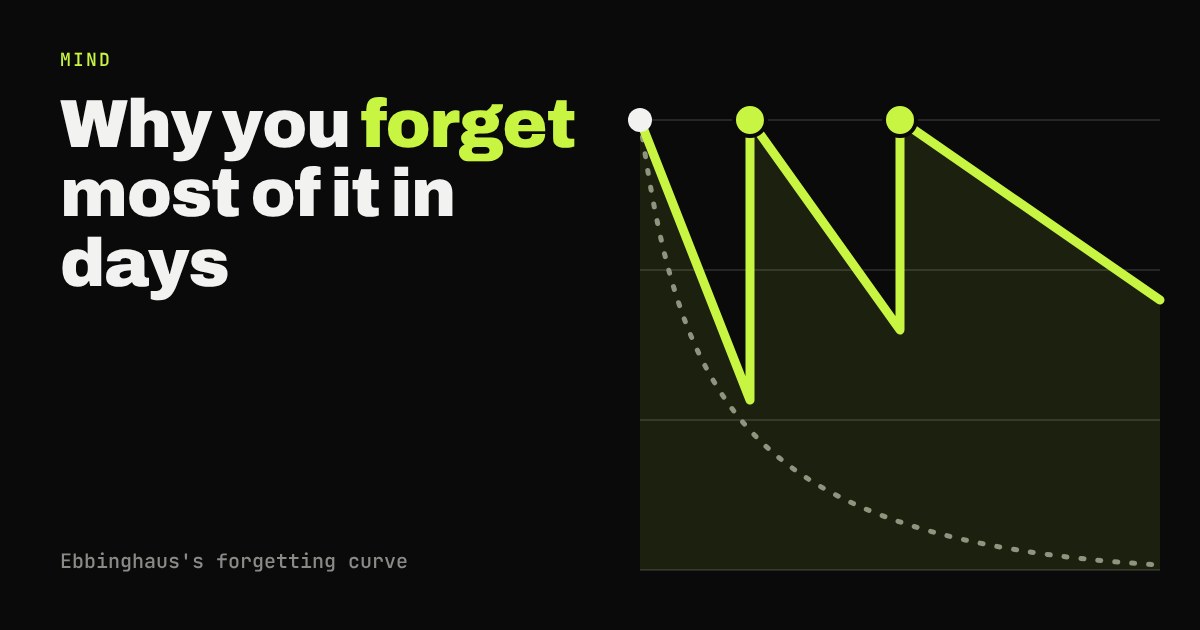
In the 1880s Hermann Ebbinghaus learned lists of nonsense syllables, tested himself after delays from 20 minutes to 31 days, and drew the first forgetting curve: a steep early drop, then a long tail.
Play with a simple model of that curve. Tap the chart to schedule reviews and watch each one reset the memory and slow the next fall. Four reviews crammed into one day barely help; the same four spread over two weeks leave far more at day 30. It's the idea behind spaced-repetition apps, and you can feel it in 30 seconds.
Deep dive · 4 min
More in Mind
View all →
Why a blink of blank screen hides big changes: change blindness
Show someone two nearly identical pictures with a blink of blank screen between them, and a large change can stay hidden for many seconds. This is change…
Why you can't hold 12 digits but can hold 3 years: working memory chunks
Try to hold 149217891945 in your head and it slips away. Read it as 1492, 1789, 1945 and it sticks. The digits are the same; the number of things to hold is…
Why you can't ignore the word and name the colour: the Stroop effect
Read the word, then name its ink colour: you can't turn reading off. In 1886 Cattell noticed that people read words faster than they name colours, and in 1935…
Every eye has a hole in its vision, and your brain paints over it
Every one of your eyes has a hole in its vision, about ten Moons wide, and you have never seen it. It is where the optic nerve leaves the retina, a patch with…
Why one more candle lights a dark room but vanishes in a bright one
Add one candle to a dark room and everything changes. Add one to a room with a hundred and nobody notices. Your senses don't measure differences in amounts…
Why you can't tickle yourself (and how a robot can fix that)
Every time you move, your brain keeps a copy of the command and uses it to predict what you're about to feel. Sensations that match the prediction get turned…