Why a blink of blank screen hides big changes: change blindness
30seconds
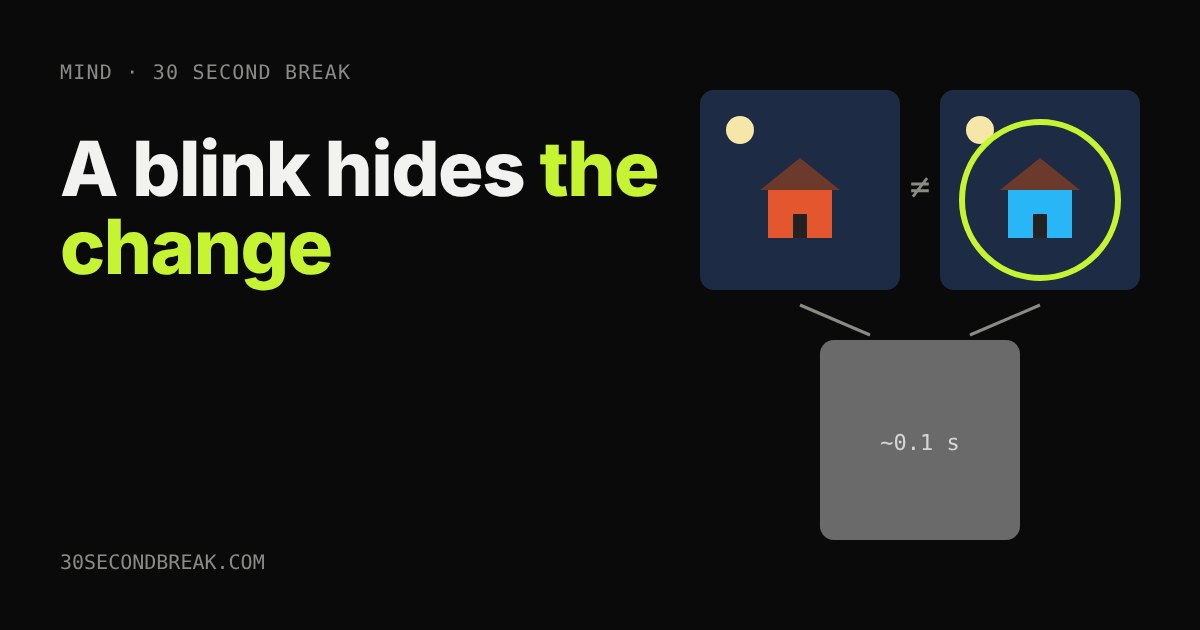
Show someone two nearly identical pictures with a blink of blank screen between them, and a large change can stay hidden for many seconds. This is change blindness.
Flicker a scene yourself, hunt for the one object that changes, then switch the blank off and watch the same change jump out. Find out why your brain stores so little, what the blank takes away, and why fewer than half of people noticed when a stranger was swapped mid-conversation.
Deep dive · 4 min
More in Mind
View all →
Why a number you know is useless still drags your guess: the anchoring effect
Spin a wheel that is rigged to stop on 10 or on 65, and people's guesses at the share of African countries in the UN swing from about 25% to about 45%. The…
Why the same circle looks smaller among big ones: the Ebbinghaus illusion and size contrast
Two identical orange circles, one ringed by big circles and one by small ones, and your eyes insist they differ. That is the Ebbinghaus illusion: your visual…
Why real coin flips look fake: streaks and the way we imagine randomness
Ask people to write down 100 random coin flips and they almost never include a streak of six, yet a real coin makes one about four times in five. Our gut…
Why still rocks creep upward after you stare at a waterfall: the motion aftereffect
Stare at a waterfall, then look at the rocks beside it, and they seem to crawl upward. They go nowhere, yet they move. This is the motion aftereffect, noticed…
Why you stumble naming the ink of a clashing colour word: the Stroop effect
Name the ink colour of the word GREEN printed in red and you stumble, even though the rule is trivial. In 1935 John Ridley Stroop timed it: naming the ink of…
Why a dot vanishes when you look away from it: the blind spot where the optic nerve exits
Close one eye, stare at a cross, and a dot a hand's width away simply vanishes. That is your blind spot: the place where the optic nerve leaves each eye, with…