Why bread rises: yeast only inflates the bubbles your kneading put there
30seconds
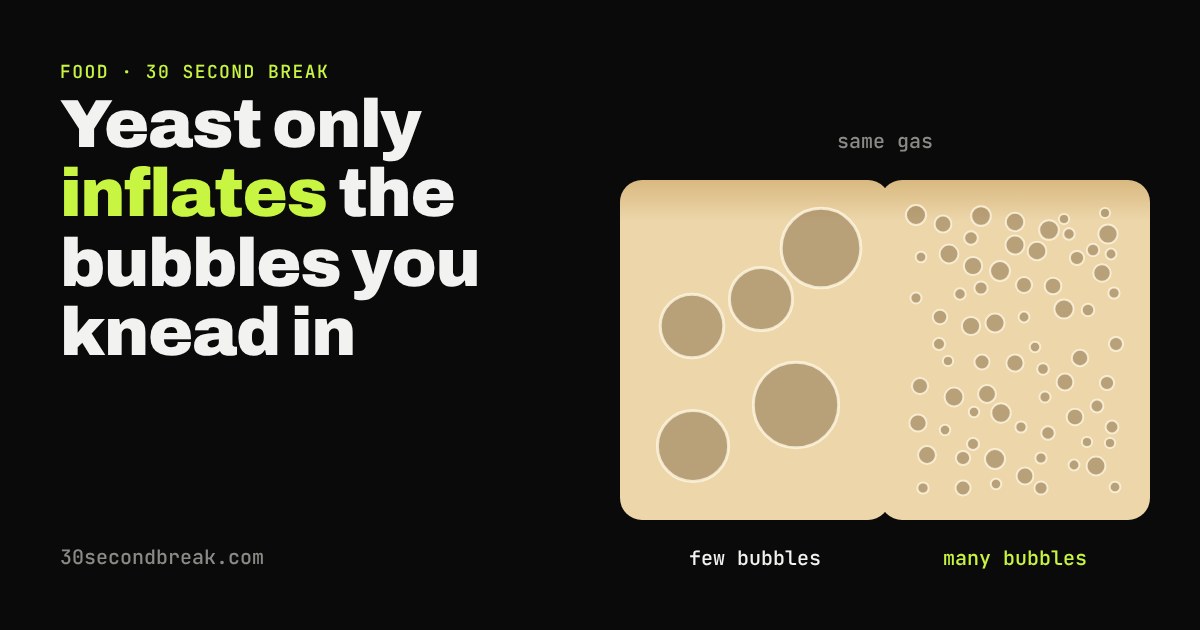
Yeast doesn't blow bubbles into dough. It only inflates the ones your kneading already folded in.
That means the number of bubbles is fixed early, and the yeast just decides how big each gets: the same gas shared between a few bubbles makes tunnels, shared between thousands makes a fine crumb.
Knead a virtual dough, proof it at different temperatures and bake it to see why a rise isn't the same as a good loaf.
Deep dive · 4 min
More in Food Science
View all →
Why a roast keeps getting hotter after you take it out: carryover cooking and the heat still on its way in
You pull the roast at 60 °C, and five minutes later the probe says 66 °C. Nothing is heating it, so where did the heat come from? The answer is that an oven…
Why a microwave leaves cold spots: a standing wave 12.2 cm long, and a chocolate bar that measures the speed of light
Microwave ovens fill a metal box with radio waves 12.2 cm long. The waves bounce off the walls and add up into a standing wave, a frozen pattern of hot spots…
Why honey never spoils: it isn't the sugar, it's the missing water
Honey is rich, sweet and nutritious, so why don't bacteria and moulds move in? Because microbes need free water, and honey's sugar holds almost all of it…
Why popcorn pops: a sealed kernel, trapped steam and a 180 °C tipping point
A popcorn kernel is a seed with a sealed hull and a little water inside. Heat it and the water can't boil away, so steam pressure builds, like a tiny pressure…
Why salt makes ice cream freeze: ice melting below 0 °C pulls out the heat
Ice is already at 0 °C, so how can a handful of rock salt make it colder? Because salt makes ice want to melt below 0 °C, and melting costs energy: about 334…
Why chocolate needs tempering: cocoa butter can freeze six ways, and only one snaps
Two bars of dark chocolate can share every ingredient and still differ completely: one glossy, snappy and firm, the other dull and crumbly. The secret is cocoa…