Why salt makes ice cream freeze: ice melting below 0 °C pulls out the heat
30seconds
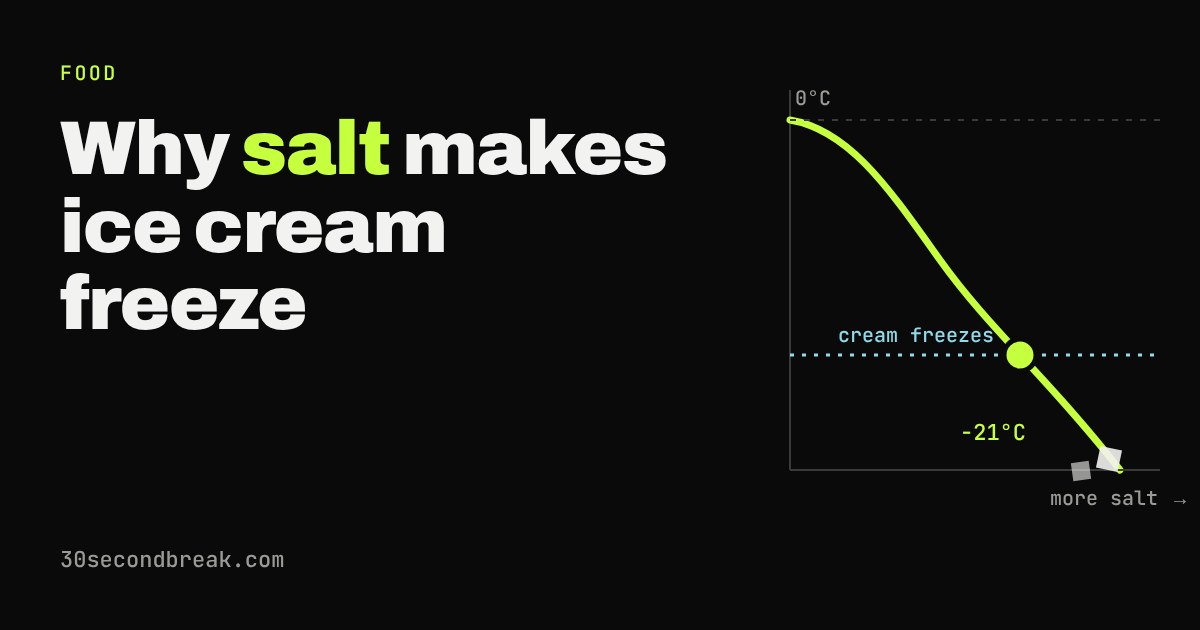
Ice is already at 0 °C, so how can a handful of rock salt make it colder? Because salt makes ice want to melt below 0 °C, and melting costs energy: about 334 joules per gram, taken from the bucket and the cream.
The effect has a floor. A salt-and-water brine bottoms out at the eutectic, 23.3% salt by mass and −21.1 °C. Drag along the brine curve, then churn a tub to see why plain ice can chill cream but only a salty bath can freeze it.
More in Food Science
View all →
Why chocolate needs tempering: cocoa butter can freeze six ways, and only one snaps
Two bars of dark chocolate can share every ingredient and still differ completely: one glossy, snappy and firm, the other dull and crumbly. The secret is cocoa…
Why a wet steak won't brown: boiling water caps the surface at 100 °C
Put a wet steak in a hot pan and it goes grey and steams. Pat it dry and it forms a dark, savoury crust. The pan is equally hot both times. The difference is a…
Why oil and water mix in mayonnaise: an egg yolk coats every droplet
Oil and water refuse to mix, yet mayonnaise is about two-thirds to four-fifths oil and holds its shape on a spoon. One egg yolk does the work: its molecules…
Why popcorn pops: a pea-sized pressure cooker that gives way at 180 °C
A popcorn kernel is a pressure cooker the size of a pea. Its tough hull seals in about 14% water, so as the pan heats, the water cannot boil away and the…
Why salt makes ice cream freeze: the cold that ice and salt create
Ice is already cold, so why does salt make ice cream freeze? Because salt does not add cold. It stops the ice and water from staying in balance at 0 °C…
Egg yolk sets at a lower temperature than the white. So why is it runny?
An egg yolk sets at about 70 °C. Most of the white needs about 80 °C. So why does a soft-boiled egg come out with a firm white and a runny yolk? Because…