How astronomers find planets by their shadow: the dip in starlight
30seconds
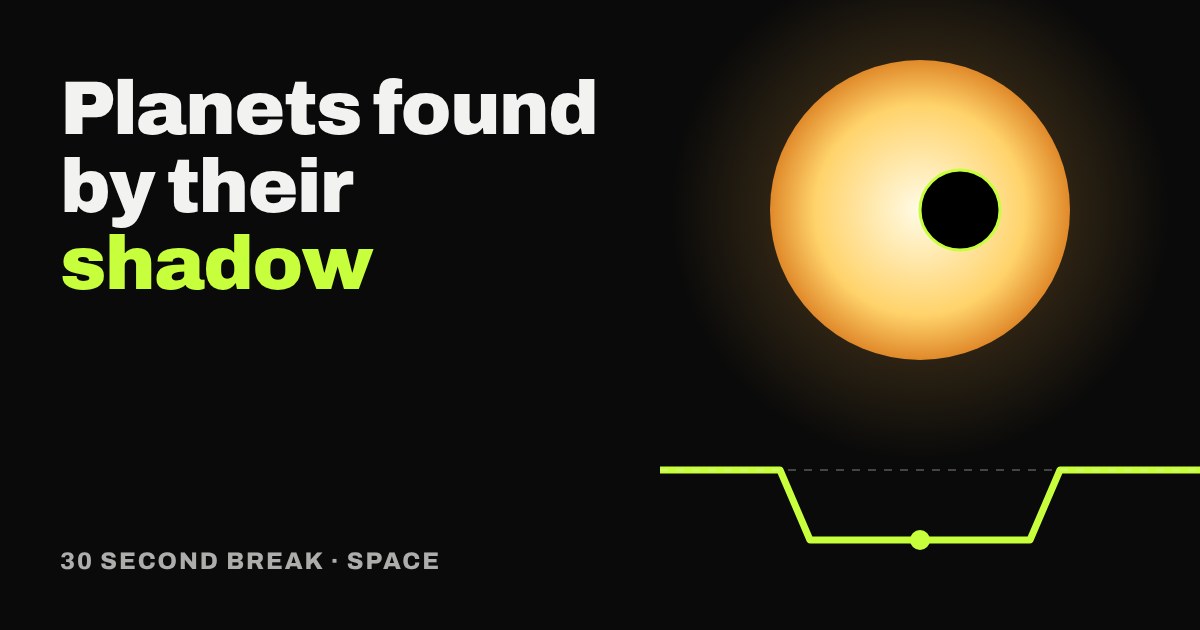
Most planets around other stars are far too faint to see directly, so astronomers watch the star instead. When a planet crosses its face, a tiny dark disc blocks a sliver of light, and the brightness dips by the ratio of the two areas: about 1% for a Jupiter, about 0.008% for an Earth.
Play with the planet's size, its orbit and its tilt, and see why most planets never line up and why one dip is only a rumour until it repeats.
Deep dive · 4 min
More in Earth & Space
View all →
Why there are two high tides a day: the Moon pulls the near sea harder and the far sea softer
The sea rises twice a day, not once, and the second high tide happens on the side of the Earth facing away from the Moon. Why? The Moon pulls the near ocean a…
Why the Moon changes shape: always half lit, and only part of it faces you
Ask why the Moon changes shape and most people blame the Earth's shadow. It is a natural guess, and it is wrong: the Moon is half lit by the Sun all the time…
Why planets speed up near the Sun: Kepler's equal-areas law
Earth moves at 30.29 km/s near 3 January and 29.29 km/s near 4 July, with nothing pushing it along. The rule behind the change is Kepler's equal-areas law: a…
Why rockets drop their tanks on the way up: the rocket equation and staging
Orbit isn't about height. It's about speed: roughly 7.8 km/s sideways, and about 9 to 10 km/s of total speed gain once gravity and air drag take their cut. The…
Why a cannonball fired hard enough never lands: Newton's cannon and the orbit
Fire a cannonball horizontally from a mountaintop and it lands some distance away. Fire it harder and it lands farther. Fire it hard enough and the Earth's…
How astronomers measure a star's distance by looking from both sides of the Earth's orbit: parallax
Hold a thumb at arm's length and blink one eye, then the other: the thumb jumps against the background. Astronomers do the same with the whole orbit of the…