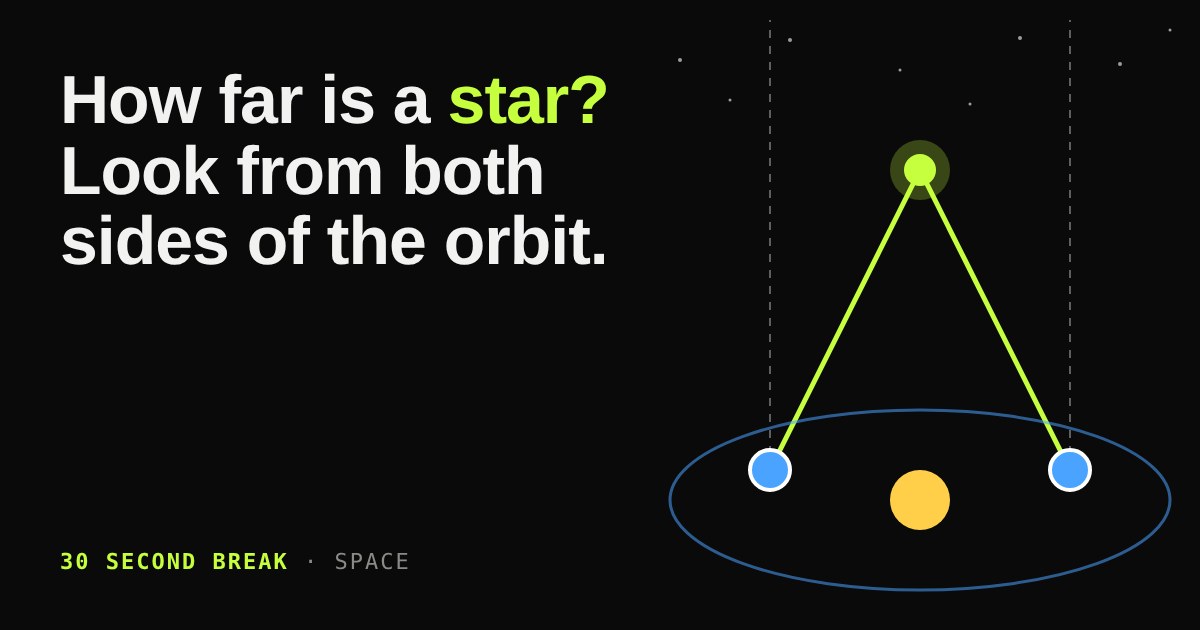
How astronomers measure a star's distance by looking from both sides of the Earth's orbit: parallax
30seconds
Hold a thumb at arm's length and blink one eye, then the other: the thumb jumps against the background. Astronomers do the same with the whole orbit of the Earth as their pair of eyes. A nearby star seems to wobble against the far stars over a year, and the size of the wobble is its parallax.
Distance in parsecs is simply 1 divided by the parallax in arcseconds. Bessel measured it for 61 Cygni in 1838, and Gaia now does it to millionths of an arcsecond. Drag the Earth, change the distance, and watch the wobble shrink.
Deep dive · 4 min
More in Earth & Space
View all →
Why the Moon always shows us the same face: tidal locking
The Moon does spin. It turns exactly once for every trip around the Earth, so the same face always points our way. Walk around a chair while always facing it…
Why one day on Mercury lasts two Mercury years
Mercury circles the Sun in 88 Earth days and spins once every 58.6 days. That odd pairing, three spins for every two orbits, means one sunrise to the next…
Earth is closest to the Sun in January. So why is that winter?
Summer can't be caused by being closer to the Sun: Earth makes its closest pass around 3 January and is farthest around 4 July. The distance changes by only…
Why astronauts float: the space station never stops falling
Astronauts on the International Space Station look weightless, but at 400 km up, Earth's gravity is still about 90% as strong as on the ground. The trick is…
Why Mars sometimes walks backwards across the sky
Every 26 months or so, Mars slows down, stops, and drifts backwards against the stars for a couple of months before carrying on. Ancient astronomers built…
Why we only ever see one side of the Moon
The Moon always shows us the same face, so it's easy to assume it doesn't spin. It does. It turns exactly once for every orbit, about every 27.3 days, so the…