Why planets speed up near the Sun: Kepler's equal-areas law
30seconds
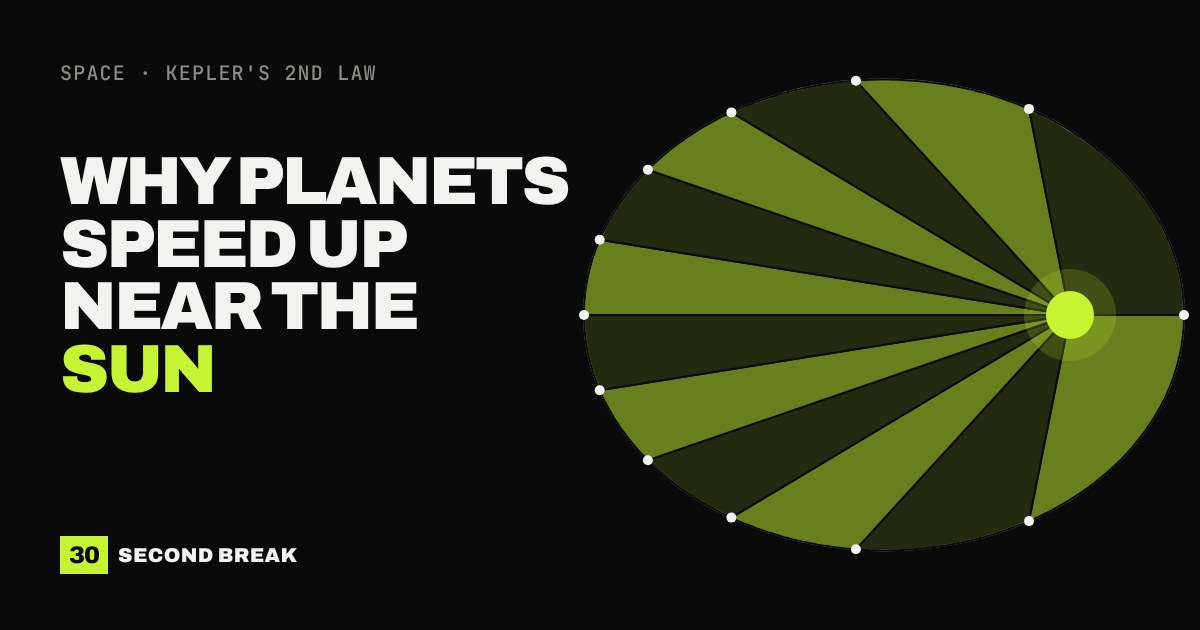
Earth moves at 30.29 km/s near 3 January and 29.29 km/s near 4 July, with nothing pushing it along. The rule behind the change is Kepler's equal-areas law: a line from the Sun to a planet sweeps out equal areas in equal times.
Stretch an orbit yourself, watch twelve equal-time wedges change shape but never size, and see why Halley's comet is about 60 times faster at its closest than at its farthest.
More in Earth & Space
View all →
Why rockets drop their tanks on the way up: the rocket equation and staging
Orbit isn't about height. It's about speed: roughly 7.8 km/s sideways, and about 9 to 10 km/s of total speed gain once gravity and air drag take their cut. The…
Why a cannonball fired hard enough never lands: Newton's cannon and the orbit
Fire a cannonball horizontally from a mountaintop and it lands some distance away. Fire it harder and it lands farther. Fire it hard enough and the Earth's…
How astronomers measure a star's distance by looking from both sides of the Earth's orbit: parallax
Hold a thumb at arm's length and blink one eye, then the other: the thumb jumps against the background. Astronomers do the same with the whole orbit of the…
Why the Moon always shows us the same face: tidal locking
The Moon does spin. It turns exactly once for every trip around the Earth, so the same face always points our way. Walk around a chair while always facing it…
Why one day on Mercury lasts two Mercury years
Mercury circles the Sun in 88 Earth days and spins once every 58.6 days. That odd pairing, three spins for every two orbits, means one sunrise to the next…
Earth is closest to the Sun in January. So why is that winter?
Summer can't be caused by being closer to the Sun: Earth makes its closest pass around 3 January and is farthest around 4 July. The distance changes by only…