Why a ball beats a hoop down any ramp: where the mass sits decides the race
30seconds
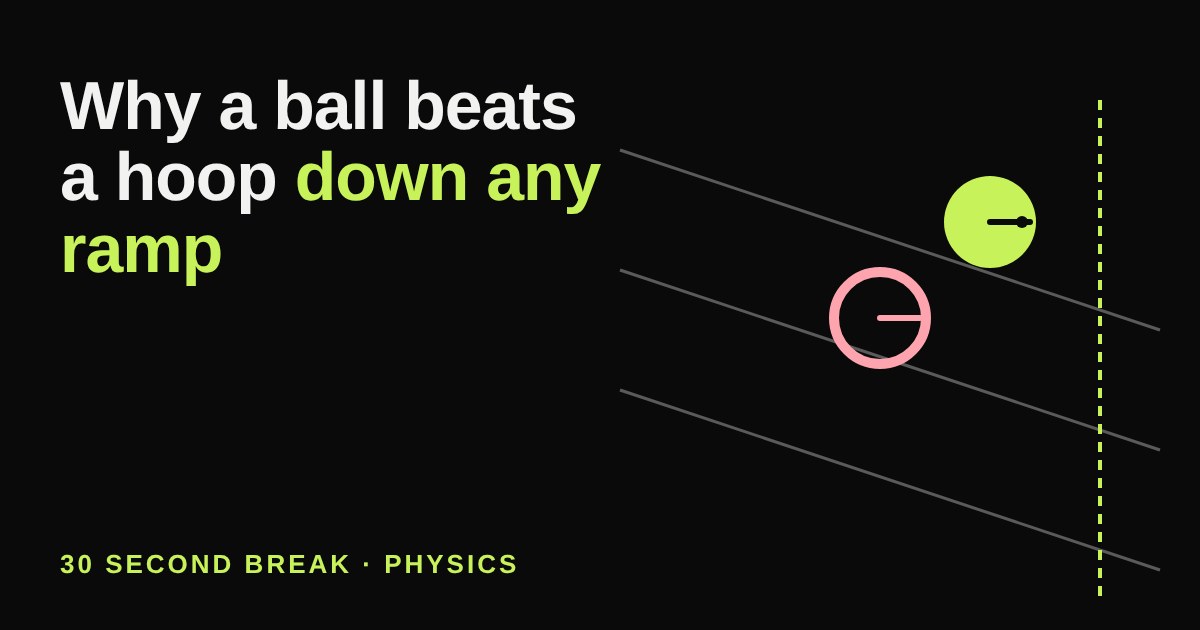
Put a hoop, a solid disc and a solid ball at the top of a ramp and let go. The ball wins, then the disc, then the hoop, every time, whatever their mass, size or the steepness of the slope.
The reason is where the mass sits. A rolling object pays part of its energy into spinning, and the farther the mass is from the axle, the more it pays. Mass and radius cancel out of the maths completely. Race them yourself and watch the order never change.
Deep dive · 4 min
More in Physics
View all →
Why a small push at the right beat builds a huge swing: resonance and the narrow peak
Every child learns to pump a swing without a lesson: small shoves, well timed, build a huge ride, while big shoves at the wrong moment achieve nothing. That…
Why a skater spins faster when she pulls her arms in: angular momentum and r squared
A skater starts a slow spin with her arms wide, pulls them in, and blurs into a fast spin with no push from anything. The trick is a quantity that cannot…
Why a small ball on a big ball shoots up nine times higher: the two-step bounce
Drop a tennis ball on top of a basketball and the small ball can fly far above the height it fell from. Nothing is cheating: it is a two-step bounce. The floor…
Why the sky is blue and the sunset red: Rayleigh scattering and the length of the air
The sky is blue and the sunset is red, yet the sunlight is the same. Air scatters short blue waves about four times more strongly than long red ones, a…
Why a siren drops in pitch as it passes: the Doppler effect
An ambulance siren sounds high as it comes at you and drops the moment it passes, yet the driver hears one steady note. The trick is in how crests per second…
Why light bends in water: the lifeguard's shortest-time path (Fermat's principle)
A lifeguard runs faster than she swims, so the quickest route to a swimmer is not a straight line. It bends at the shoreline, and the bend follows one tidy…