Why a small ball on a big ball shoots up nine times higher: the two-step bounce
30seconds
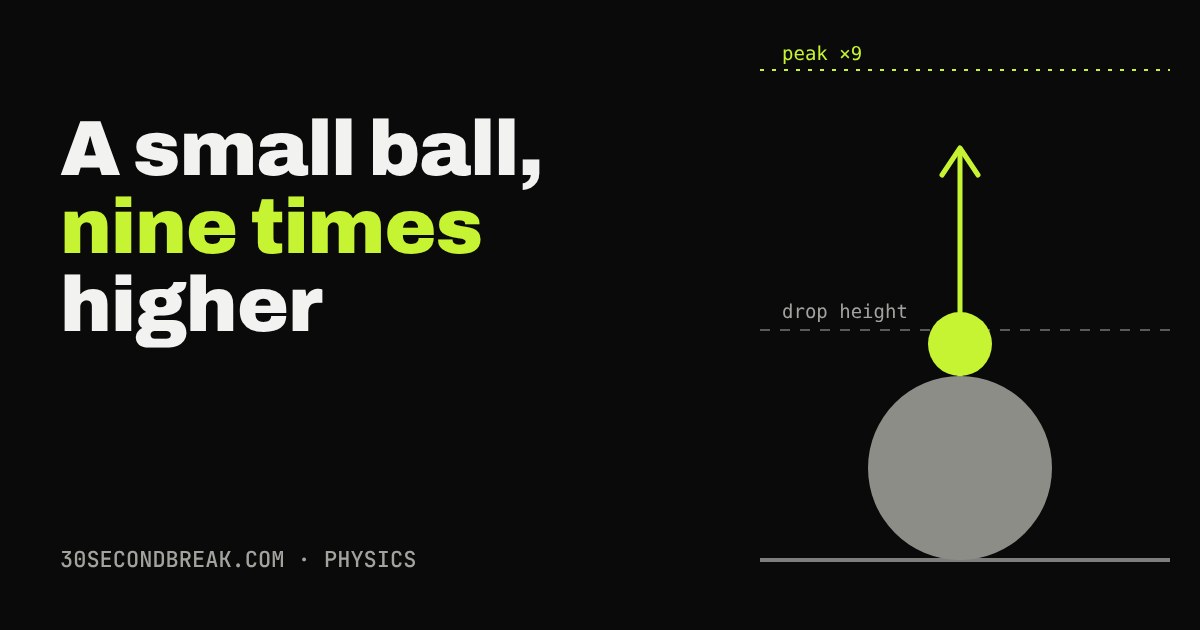
Drop a tennis ball on top of a basketball and the small ball can fly far above the height it fell from. Nothing is cheating: it is a two-step bounce. The floor flips the big ball upward while the small one is still falling, and a bouncy collision between the two sends the light ball away three times faster than it arrived.
Speed three times higher means nine times the height. Stack a third ball on top and the ideal limit is seven times the speed and forty-nine times the height. Build the stack, change the mass ratio and bounciness, and watch the energy trade.
Deep dive · 4 min
More in Physics
View all →
Why the sky is blue and the sunset red: Rayleigh scattering and the length of the air
The sky is blue and the sunset is red, yet the sunlight is the same. Air scatters short blue waves about four times more strongly than long red ones, a…
Why a siren drops in pitch as it passes: the Doppler effect
An ambulance siren sounds high as it comes at you and drops the moment it passes, yet the driver hears one steady note. The trick is in how crests per second…
Why light bends in water: the lifeguard's shortest-time path (Fermat's principle)
A lifeguard runs faster than she swims, so the quickest route to a swimmer is not a straight line. It bends at the shoreline, and the bend follows one tidy…
Why a spinning ball curves in mid-air: the Magnus effect
Clip a football with the side of your boot and it bends around a wall with nothing touching it in the air. A spinning ball drags air around with its surface…
Why a boat's wake is always a 39° V: Kelvin's wedge
Behind every boat spreads a V of ripples, and it is always about 39° wide, whether the boat crawls or speeds. Lord Kelvin worked out why in 1887: only waves…
Why the bottom of a dropped Slinky hangs in mid-air: a wave has to bring the news
Hold a Slinky by its top, let it stretch, and let go. The top rushes down while the bottom coil hovers, apparently ignoring gravity, until the collapsing coils…