Why real coin flips look fake: streaks and the way we imagine randomness
30seconds
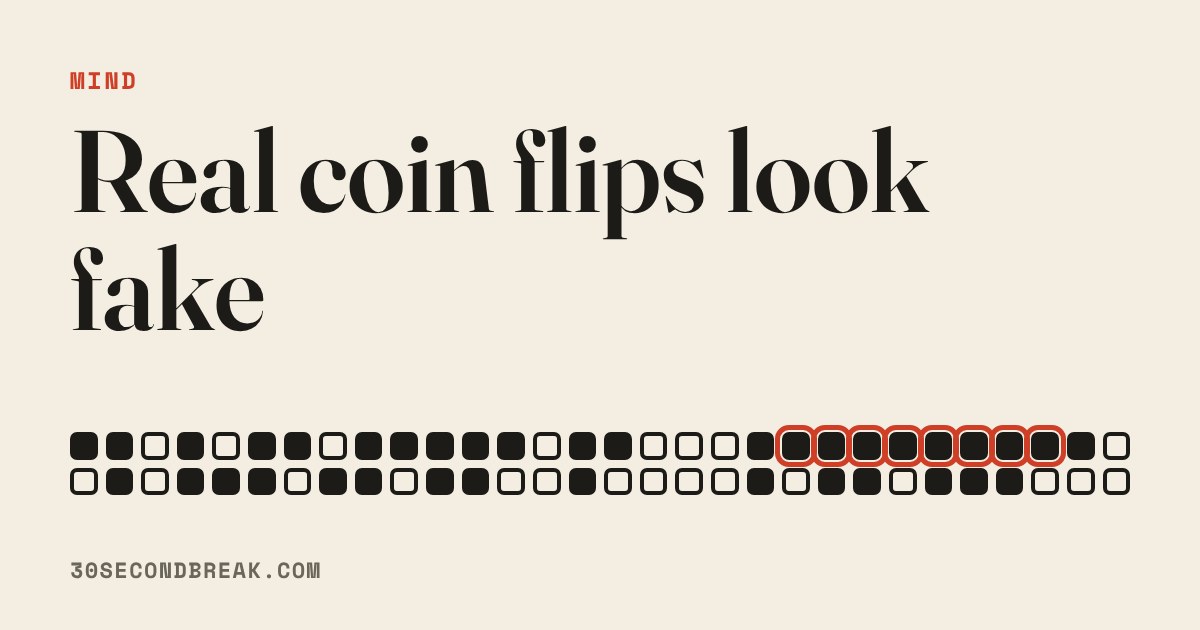
Ask people to write down 100 random coin flips and they almost never include a streak of six, yet a real coin makes one about four times in five.
Our gut expects short sequences to look evenly mixed, so we switch sides far too often. A fair coin has no memory, so streaks are normal.
Try to spot the real coin against a faked strip, then fake 50 flips yourself and see how you compare with the odds.
More in Mind
View all →
Why still rocks creep upward after you stare at a waterfall: the motion aftereffect
Stare at a waterfall, then look at the rocks beside it, and they seem to crawl upward. They go nowhere, yet they move. This is the motion aftereffect, noticed…
Why you stumble naming the ink of a clashing colour word: the Stroop effect
Name the ink colour of the word GREEN printed in red and you stumble, even though the rule is trivial. In 1935 John Ridley Stroop timed it: naming the ink of…
Why a dot vanishes when you look away from it: the blind spot where the optic nerve exits
Close one eye, stare at a cross, and a dot a hand's width away simply vanishes. That is your blind spot: the place where the optic nerve leaves each eye, with…
Why a falling ruler slips through your fingers: gravity as a reaction-time stopwatch
Drop a ruler without warning and you will not catch it at the top. The place where your fingers close is a stopwatch reading: the distance it fell is ½ g t²…
Why you forget most of it in days: Ebbinghaus's forgetting curve
In the 1880s Hermann Ebbinghaus learned lists of nonsense syllables, tested himself after delays from 20 minutes to 31 days, and drew the first forgetting…
Why a blink of blank screen hides big changes: change blindness
Show someone two nearly identical pictures with a blink of blank screen between them, and a large change can stay hidden for many seconds. This is change…