Why you stumble naming the ink of a clashing colour word: the Stroop effect
30seconds
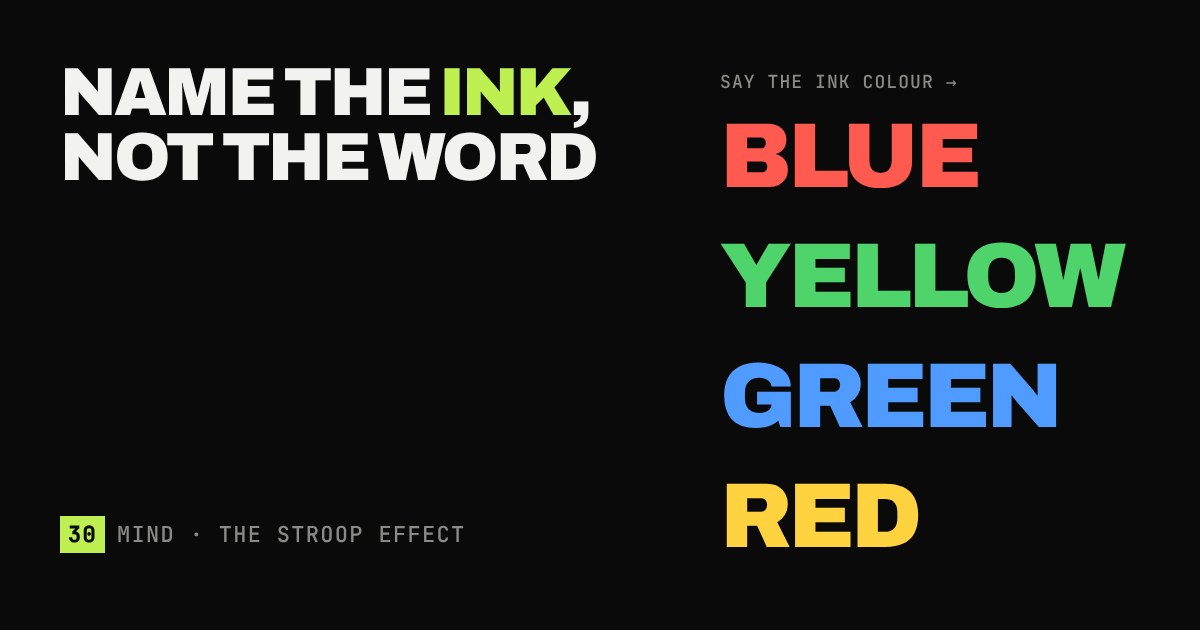
Name the ink colour of the word GREEN printed in red and you stumble, even though the rule is trivial. In 1935 John Ridley Stroop timed it: naming the ink of clashing colour words took about 74% longer than naming plain colour patches.
Play two quick rounds and measure your own gap, then see why reading is such a strong habit that it barges in uninvited, and why the clash only works in one direction.
Deep dive · 3 min
More in Mind
View all →
Why a dot vanishes when you look away from it: the blind spot where the optic nerve exits
Close one eye, stare at a cross, and a dot a hand's width away simply vanishes. That is your blind spot: the place where the optic nerve leaves each eye, with…
Why a falling ruler slips through your fingers: gravity as a reaction-time stopwatch
Drop a ruler without warning and you will not catch it at the top. The place where your fingers close is a stopwatch reading: the distance it fell is ½ g t²…
Why you forget most of it in days: Ebbinghaus's forgetting curve
In the 1880s Hermann Ebbinghaus learned lists of nonsense syllables, tested himself after delays from 20 minutes to 31 days, and drew the first forgetting…
Why a blink of blank screen hides big changes: change blindness
Show someone two nearly identical pictures with a blink of blank screen between them, and a large change can stay hidden for many seconds. This is change…
Why you can't hold 12 digits but can hold 3 years: working memory chunks
Try to hold 149217891945 in your head and it slips away. Read it as 1492, 1789, 1945 and it sticks. The digits are the same; the number of things to hold is…
Why you can't ignore the word and name the colour: the Stroop effect
Read the word, then name its ink colour: you can't turn reading off. In 1886 Cattell noticed that people read words faster than they name colours, and in 1935…