Why a CD takes 44,100 snapshots a second: Nyquist and the tone that folds back
30seconds
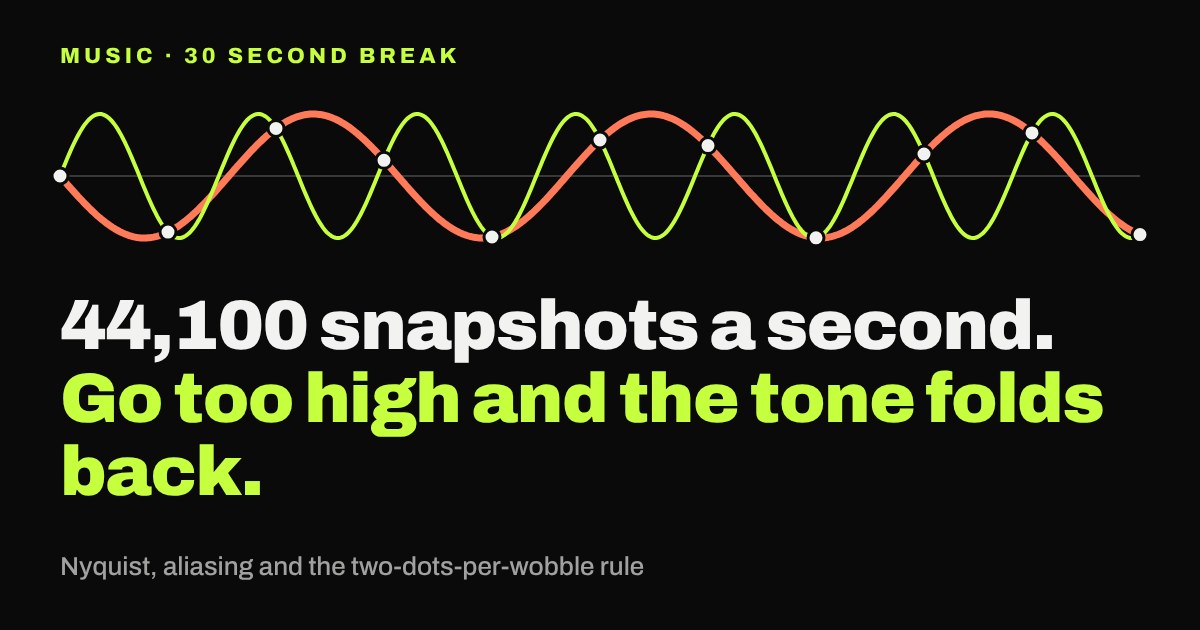
A CD stores music as 44,100 numbers a second, with nothing in between. Sample more than twice as fast as the highest pitch and the wave can be rebuilt exactly. Go past half the rate and the dots fold the tone back down into a different, lower note.
Drag a tone across the line in the interactive, then see why 44.1 kHz came from video tape and why phone calls sound dull.
Deep dive · 4 min
More in Music & Sound
View all →
Why dragging a bow makes a steady note: stick-slip and Helmholtz's travelling kink
A bow moves at a steady speed, yet the string under it vibrates in an exact rhythm hundreds of times a second. The secret is stick-slip: rosin grips the…
Why two steady rhythms can fight and still groove: the hidden grid of 3 against 2
Tap a steady beat with one hand and three evenly spaced taps in the same time with the other, and you get a 3:2 polyrhythm: two perfectly regular clocks that…
Why you hear a note that isn't there: the missing fundamental
Play only 220, 330 and 440 hertz and most people hear a note at 110 hertz — a frequency that is not in the sound at all. This is the missing fundamental: the…
Why two almost-equal notes make a wobble: beats and the piano tuner's trick
Play two almost-equal notes together and you hear one pitch that swells and fades. Those swells are beats, and their rate is simply the difference in…
Why a piano can never be perfectly in tune: twelve fifths overshoot seven octaves
Climb twelve perfect fifths and you should land back on your starting note, seven octaves up. You don't: you overshoot by 23.46 cents, nearly a quarter of a…
Why a flute and a clarinet sound different on the same note: harmonics and timbre
Play the same note on a flute and a clarinet, at the same pitch and loudness, and you can still tell them apart at once. That difference is called timbre, and…