Why a sentence can nest forever on paper but not in your head: centre-embedding
30seconds
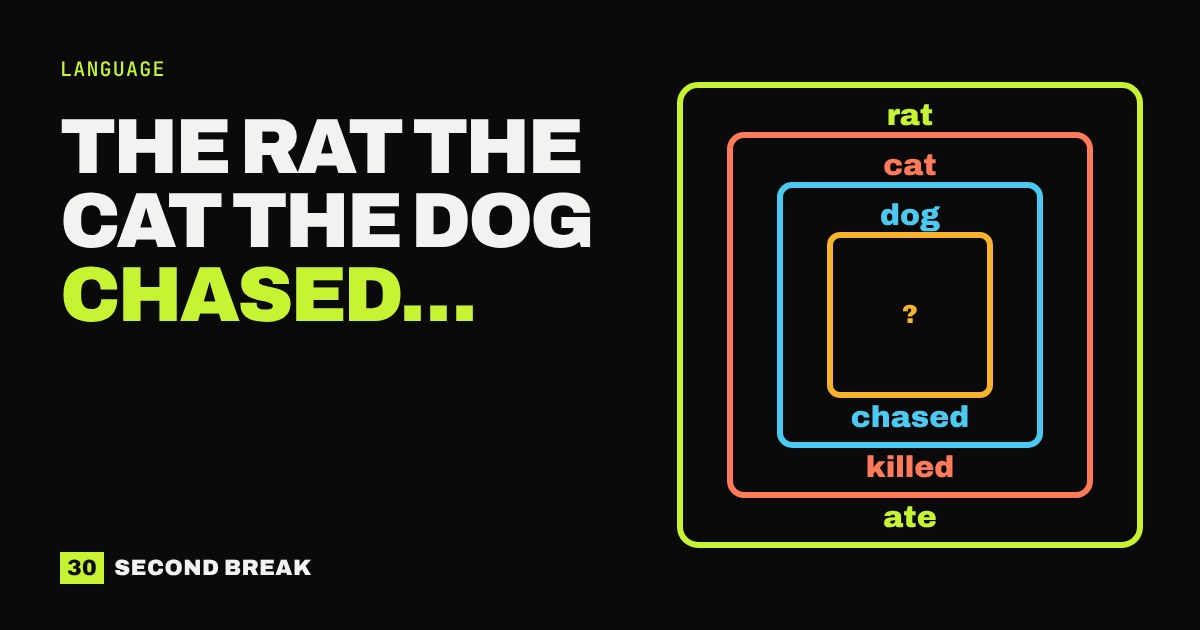
The rat the cat the dog chased killed ate the malt. It is perfectly grammatical, and almost nobody can read it. English lets you tuck one clause inside another without limit, but a reader has to keep every noun waiting until its verb finally arrives, in reverse order.
Build the sentence one nested level at a time, watch the pile of unfinished nouns grow, then chain the same words so each verb follows its noun. And see why a sentence with a verb missing can feel better than the complete one.
Deep dive · 4 min
More in Language
View all →
Why 'The old man the boat' stops you cold: garden-path sentences and a brain that guesses
Read "The old man the boat." and your brain probably crashes at the fifth word. It guessed "the old man" was one person and waited for a verb that never came…
Why Latin p became English f: Grimm's law and the sound-shift chain
Latin says pes, English says foot. Latin tres, English three. Latin cornu, English horn. The swap is not random: when the Germanic languages split off, their…
Why English plurals say s, z or iz: the wug test
Say 'cats' and 'dogs' out loud and listen to the last sound. One is a hiss, the other a buzz, and 'buses' adds a whole extra syllable. English spells all three…
Why the most common word is twice as common as the next: Zipf's law
Sort every word in a book from most to least common and a pattern appears: the top word is about twice as common as the second, three times as common as the…
Why “The old man the boat” reads as broken: garden-path sentences
Read this: The old man the boat. If it stalled you at the end, your brain did exactly what it always does: it guessed ahead and lost the bet. A garden-path…
Why the same sound is a b to English ears and a p to Spanish ears
Say "bat" and "pat". The only physical difference is a tiny delay between your lips opening and your vocal cords buzzing, about 12 milliseconds for an English…