Why the most common word is twice as common as the next: Zipf's law
30seconds
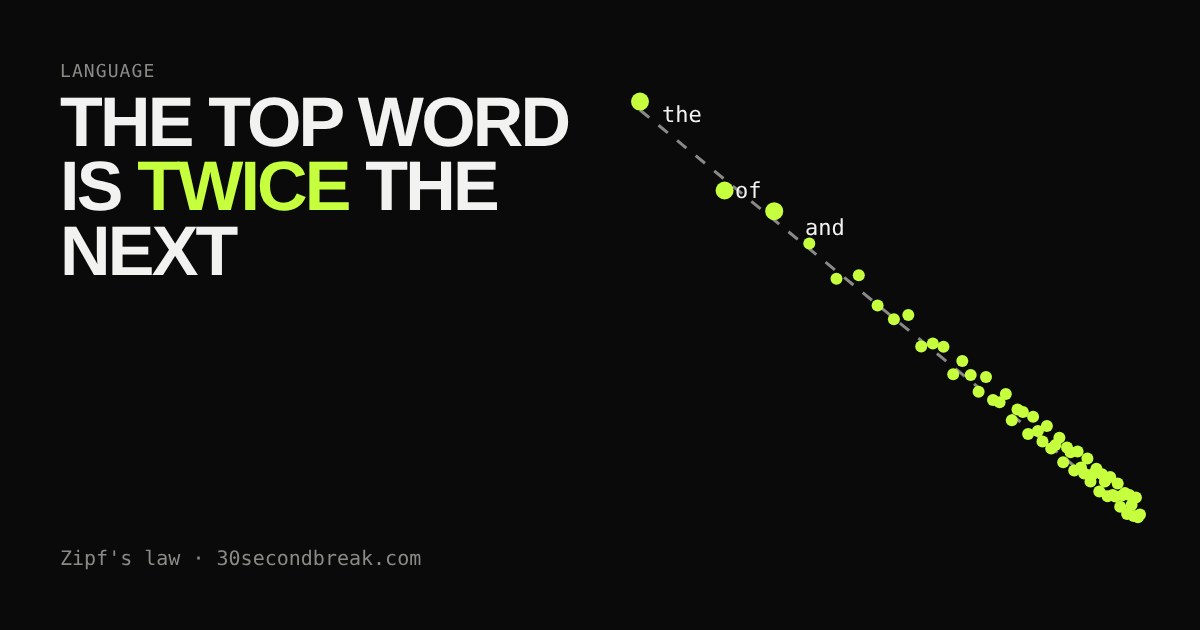
Sort every word in a book from most to least common and a pattern appears: the top word is about twice as common as the second, three times as common as the third, and so on. This is Zipf's law, named after the linguist George Kingsley Zipf.
Count the words in your own text, then let a monkey type random letters and spaces. Its gibberish draws a surprisingly similar line, which says something about how weak a test that straight line really is.
Deep dive · 5 min
More in Language
View all →
Why “The old man the boat” reads as broken: garden-path sentences
Read this: The old man the boat. If it stalled you at the end, your brain did exactly what it always does: it guessed ahead and lost the bet. A garden-path…
Why the same sound is a b to English ears and a p to Spanish ears
Say "bat" and "pat". The only physical difference is a tiny delay between your lips opening and your vocal cords buzzing, about 12 milliseconds for an English…
Why Spanish sounds faster than Vietnamese yet says just as much
Listen to Spanish or Japanese and it seems to rush past; Vietnamese or Thai can sound almost unhurried. Yet when researchers timed 170 people reading the same…
Why everyone agrees which blob is 'bouba' and which is 'kiki'
Show people a soft blob and a spiky star and ask which one is bouba and which is kiki. The words are made up, yet in the classic version of the test about 95%…
Why the most common words are the shortest: Zipf's two laws of language
Count the words in almost any long text and a strange pattern appears: the most common word turns up about twice as often as the second, three times as often…
Why English spelling doesn't match how words sound
Around 1400, English spelling roughly matched speech. Bite sounded close to "beet", meet roughly like "mate", and house like "hoose". Then, over about three…