Why a squeezed ruler bows sideways: Euler's buckling and the hollow tube
30seconds
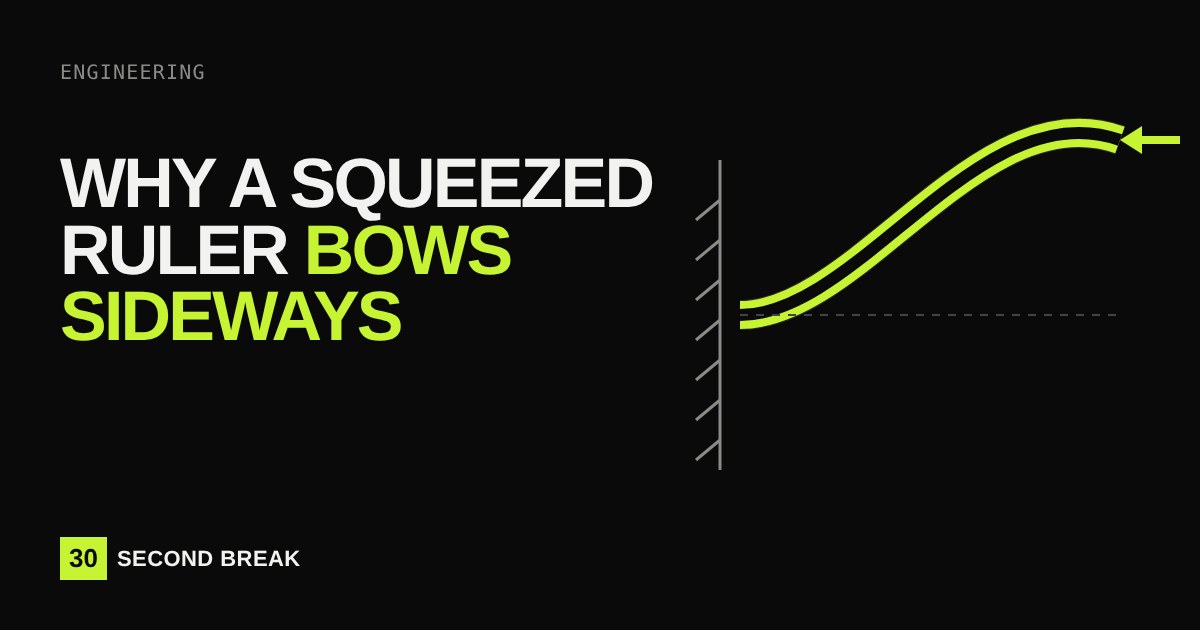
Squeeze a ruler between your palms and it doesn't crush: it bows sideways and gives way. That's buckling, and it decides how slender a column can be.
Euler worked out the threshold in 1757: the load a column can carry falls with the square of its length, and depends on stiffness and shape, not on how strong the material is. Play with a steel rod below: stretch it, hollow it out, clamp its ends, and see which fails first.
Deep dive · 4 min
More in Engineering
View all →
Why every bridge is made of triangles: a square frame folds, a triangle can't
Push on the corner of a square frame and it folds flat. Push on a triangle made of the same sticks and nothing moves. The reason is simple: three side lengths…
Why a 660-tonne steel ball swings to keep Taipei 101 still
Skyscrapers sway in the wind, and gusts that match the tower's own rhythm can make it sway more and more. Taipei 101's answer is a 660-tonne steel pendulum…
Hang a chain, flip it upside down, and you have the perfect arch
In 1675 Robert Hooke hid a building secret in an anagram. Decoded after his death, it said: as hangs a flexible cable, so, inverted, stand the touching pieces…
Why traffic jams appear out of nowhere
Sometimes a motorway grinds to a halt and then clears up with no crash, roadworks or merge in sight. That's a phantom traffic jam, and it starts with one…