Why a treatment can win in every group and still lose overall: Simpson's paradox
30seconds
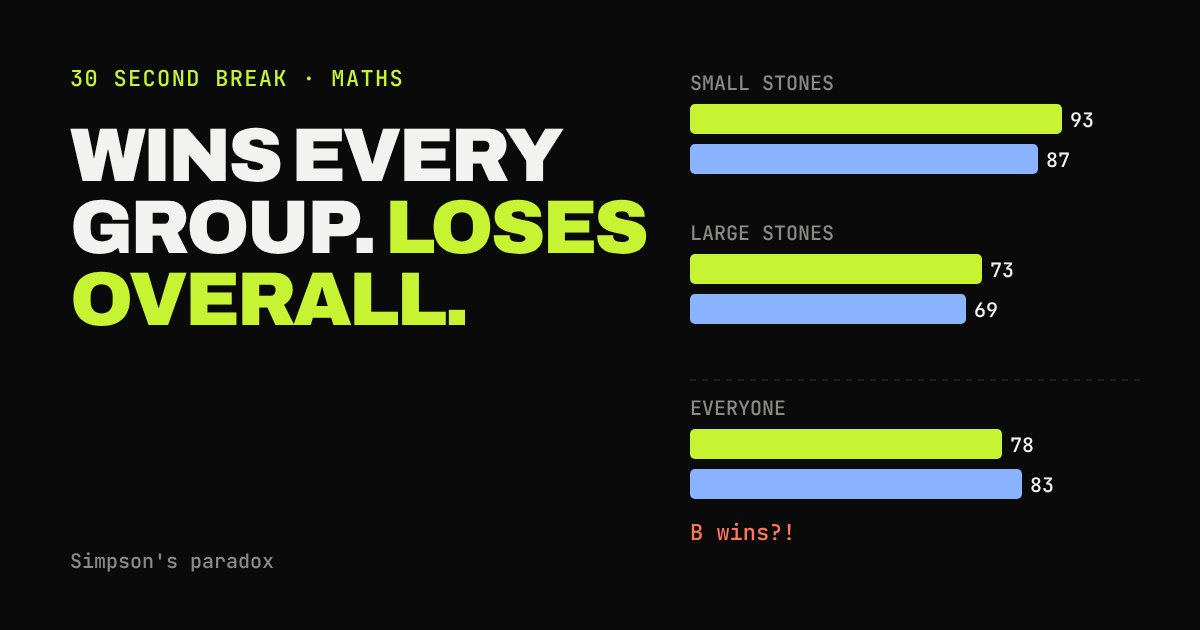
Treatment B beats Treatment A overall, yet A wins for small stones and for large stones. That is Simpson's paradox, and it is real data from a kidney-stone study.
The trick is the mix: most of A's patients had the hard large stones, most of B's had easy small ones. Drag the sliders to change who gets which treatment and watch the winner flip, then see why the same effect showed up in Berkeley's 1973 admissions figures.
Deep dive · 4 min
More in Maths
View all →
Why no walk can cross all seven bridges of Königsberg once: Euler's odd-places rule
Seven bridges, two islands, two river banks: in 1700s Königsberg nobody could find a walk crossing each bridge exactly once. Euler didn't search harder, he…
Why sunflower seeds never leave gaps: the golden angle and the Fibonacci spirals
Sunflower seeds are not placed in spirals on purpose. Each new seed turns a fixed angle from the last, and only one angle, about 137.5 degrees, leaves no bare…
Why random dice rolls draw a perfect fractal: the chaos game and the Sierpiński triangle
Pick three dots, then keep jumping halfway towards a randomly chosen one. It sounds like it should leave a grey smudge, but after a few thousand jumps a…
Why a dropped stick can find π: Buffon's needle
Drop a stick on a floor of planks and count how often it lands across a seam. The count secretly contains π: for a needle as long as the plank width, the…
Why 23 people are enough for a shared birthday: counting pairs, not people
Put 23 people in a room and the chance that two share a birthday is already 51%. It feels far too low a number, because we picture one person matching our…
Why random bounces pile up into a bell curve: the Galton board
Every ball in a Galton board makes the same blind choice at each peg: left or right, a coin flip. Yet drop enough of them and the pile always grows into the…