Why a wet steak won't brown: boiling water caps the surface at 100 °C
30seconds
Put a wet steak in a hot pan and it goes grey and steams. Pat it dry and it forms a dark, savoury crust. The pan is equally hot both times.
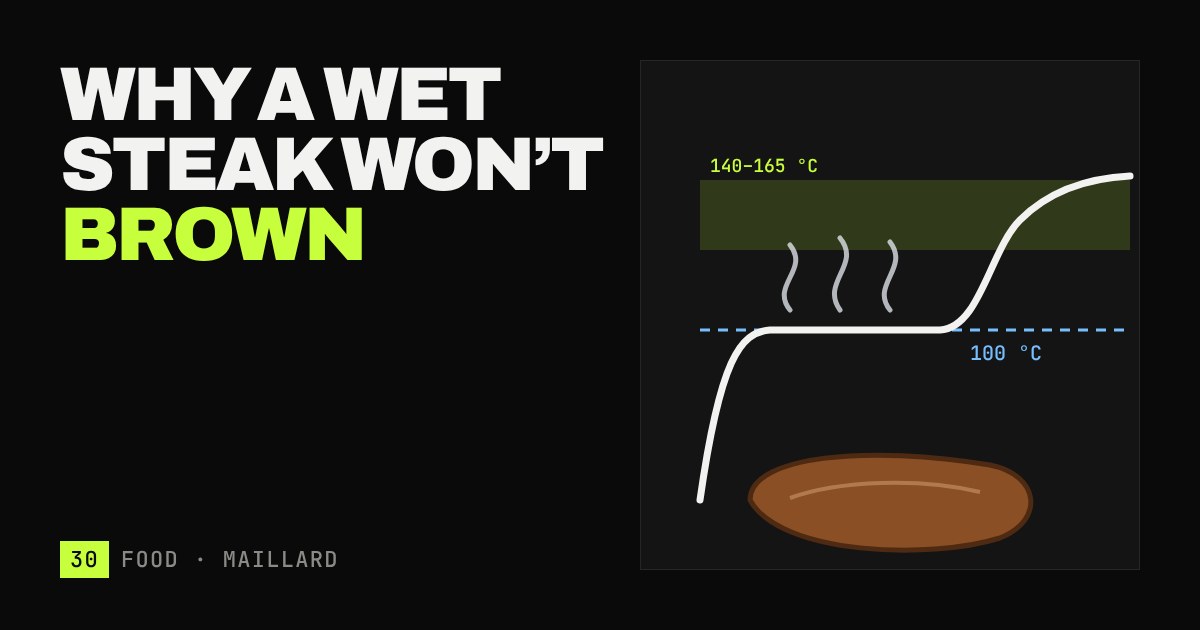
The difference is a film of water. While liquid water is on the surface, all the pan's extra heat goes into making steam, so the surface stays near 100 °C. The Maillard reaction, first described in 1912, only runs fast at about 140 to 165 °C.
Drive the pan temperature and the surface wetness yourself, and watch the temperature plateau decide when the crust starts.
Deep dive · 4 min
More in Food Science
View all →
Why oil and water mix in mayonnaise: an egg yolk coats every droplet
Oil and water refuse to mix, yet mayonnaise is about two-thirds to four-fifths oil and holds its shape on a spoon. One egg yolk does the work: its molecules…
Why popcorn pops: a pea-sized pressure cooker that gives way at 180 °C
A popcorn kernel is a pressure cooker the size of a pea. Its tough hull seals in about 14% water, so as the pan heats, the water cannot boil away and the…
Why salt makes ice cream freeze: the cold that ice and salt create
Ice is already cold, so why does salt make ice cream freeze? Because salt does not add cold. It stops the ice and water from staying in balance at 0 °C…
Egg yolk sets at a lower temperature than the white. So why is it runny?
An egg yolk sets at about 70 °C. Most of the white needs about 80 °C. So why does a soft-boiled egg come out with a firm white and a runny yolk? Because…
Chilli isn't hot: capsaicin trips the heat alarm on your tongue
A chilli is exactly as warm as the room. There is no heat in it at all. The burn comes from capsaicin, a molecule that pries open TRPV1, the gate in your…
Stale bread isn't dry: its starch has quietly turned back into crystals
Bread left on the counter turns hard and crumbly, and it looks like it dried out. It mostly didn't. In 1852 Jean-Baptiste Boussingault showed that bread sealed…