Why popcorn pops: a pea-sized pressure cooker that gives way at 180 °C
30seconds
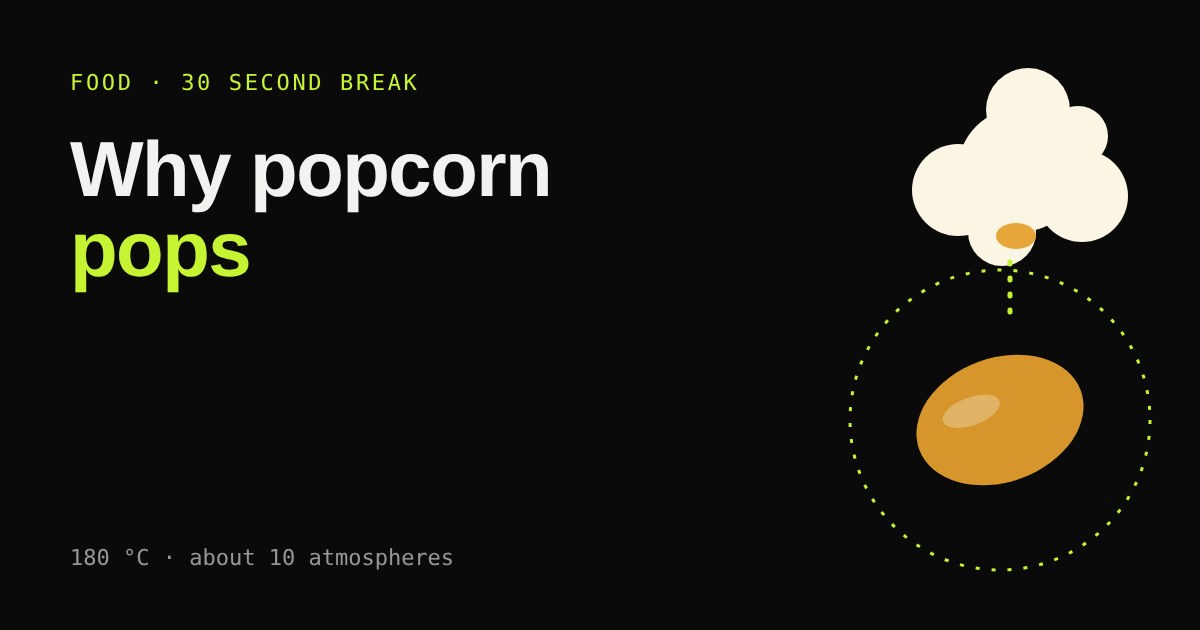
A popcorn kernel is a pressure cooker the size of a pea. Its tough hull seals in about 14% water, so as the pan heats, the water cannot boil away and the pressure builds.
At around 180 °C the steam reaches roughly 10 atmospheres and the hull gives way. The starch inside flashes into a foam that sets as the white flake you eat. Drag the heat up and watch which kernels go first.
Deep dive · 3 min
More in Food Science
View all →
Why salt makes ice cream freeze: the cold that ice and salt create
Ice is already cold, so why does salt make ice cream freeze? Because salt does not add cold. It stops the ice and water from staying in balance at 0 °C…
Egg yolk sets at a lower temperature than the white. So why is it runny?
An egg yolk sets at about 70 °C. Most of the white needs about 80 °C. So why does a soft-boiled egg come out with a firm white and a runny yolk? Because…
Chilli isn't hot: capsaicin trips the heat alarm on your tongue
A chilli is exactly as warm as the room. There is no heat in it at all. The burn comes from capsaicin, a molecule that pries open TRPV1, the gate in your…
Stale bread isn't dry: its starch has quietly turned back into crystals
Bread left on the counter turns hard and crumbly, and it looks like it dried out. It mostly didn't. In 1852 Jean-Baptiste Boussingault showed that bread sealed…
Why popcorn pops, and why some kernels never do
A popcorn kernel is a tiny, sealed pressure vessel. Its hard shell traps water inside the starchy core until heat turns that water to steam, and pressure…