Why fair coin flips end with one person owning almost everything: the yard-sale model of wealth
30seconds
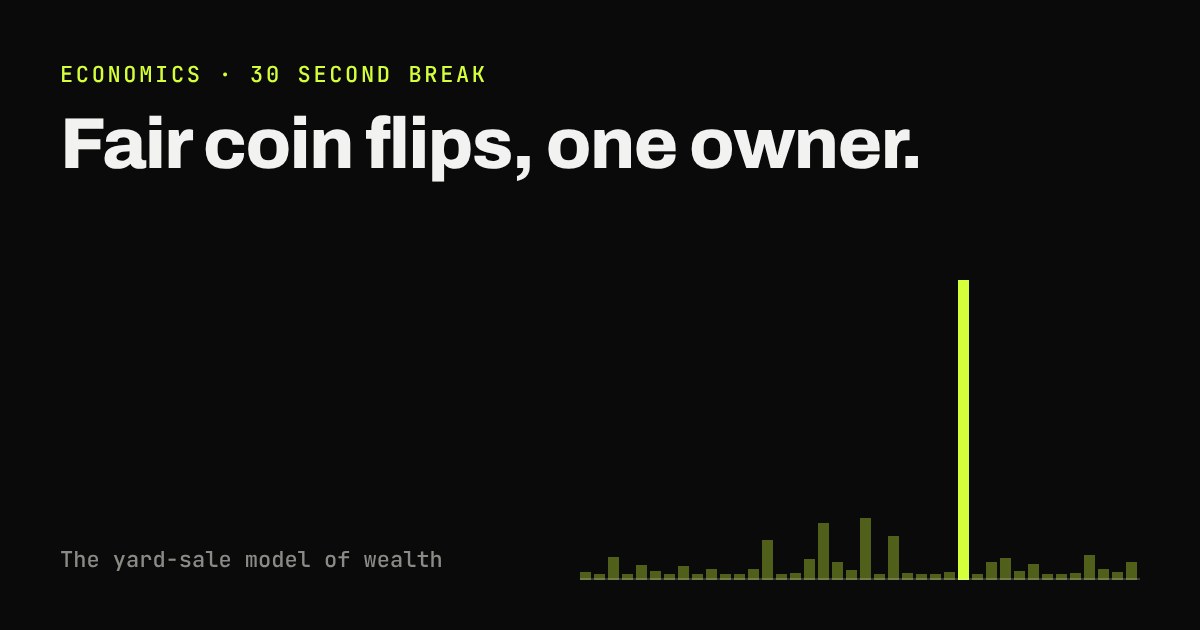
Give 60 people 100 coins each and let them trade by fair coin flips, with the stake a fixed share of the poorer person's wealth. Nobody has any skill or advantage, and every bet is 50/50.
Yet the yard-sale model ends with almost all the wealth in one pair of hands. Run it yourself, watch the Gini coefficient climb, then turn on a little redistribution and see the pile-up stop.
Deep dive · 4 min
More in Economics
View all →
Why a healthy bank can still collapse: Diamond and Dybvig's bank run
A bank keeps only a slice of your deposit as cash and lends the rest for years, so it quietly bets that almost nobody asks for their money at once. Diamond and…
Why a country that's worse at everything still gains from trade: Ricardo's comparative advantage
How can a country that is worse at everything still gain from trade? Ricardo's 1817 England-and-Portugal example says the answer is not who is faster, but what…
Why two ice-cream vendors end up side by side: Hotelling's beach
Two ice-cream vendors share a long beach, and every swimmer walks to the nearer cart. Where should each one park? Drag the carts and watch the dividing line…
Why a free shortcut can make everyone's commute longer: Braess's paradox
Build a brand-new road and every commute gets longer. In a town of 4,000 drivers, two routes each take 65 minutes. Add a free shortcut and each driver…
Why the auction winner so often overpays: the winner's curse
Why does the winner of an auction so often go home poorer? When a prize is worth the same to everyone, each bidder only has a noisy estimate, and winning means…
Why mild preferences can build a segregated town: Schelling's chequerboard
Nobody in this town wants it split into blue and orange districts. Each household only asks that a few of its neighbours look like it. Yet run the rule and the…