Why mild preferences can build a segregated town: Schelling's chequerboard
30seconds
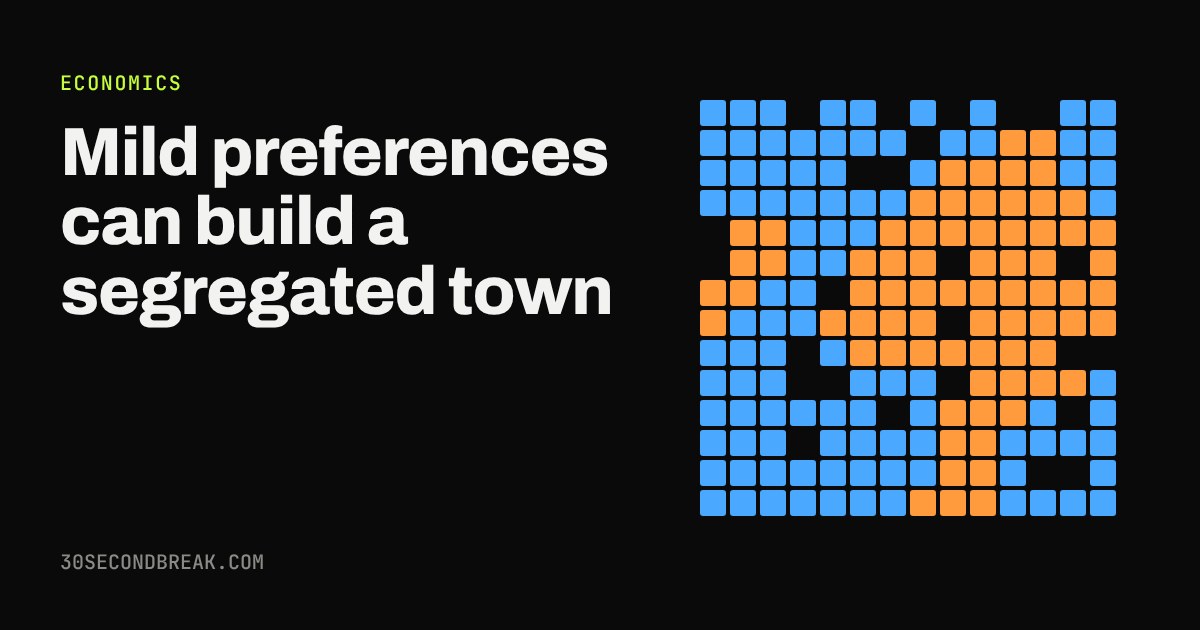
Nobody in this town wants it split into blue and orange districts. Each household only asks that a few of its neighbours look like it. Yet run the rule and the town sorts itself into neat colour blocks.
This is Schelling's segregation model, from the economist Thomas Schelling, who published it in 1971. Drag the tolerance slider, press Run and watch small preferences add up to a pattern nobody ordered.
Deep dive · 4 min
More in Economics
View all →
Why good used cars vanish from the market: Akerlof's lemons
Why can a market of willing buyers and sellers fall apart? In 1970 the economist George Akerlof showed that when only the seller knows a used car's quality…
Why rival ice-cream carts end up side by side: Hotelling's beach
Put two ice-cream carts on a long beach and each one is tempted to creep toward the other, because standing next to a rival steals customers without losing…
Why adding a road can slow every driver down: Braess's paradox
You would think a free shortcut can only help. In 1968 the mathematician Dietrich Braess showed it can make every driver slower. In our four-road example…
Why people bid more than a dollar for a dollar: Shubik's escalation trap
Auction a dollar bill with one twist: the second-highest bidder pays their bid too. It sounds harmless, yet in 1971 economist Martin Shubik reported that…
The winner's curse: why whoever wins an auction has usually overpaid
In 1983, MBA students bid on jars of coins worth exactly $8. On average they underestimated the jars, guessing $5.13. Yet the winning bids averaged $10.01, so…
Why shared fish, fields and water get used up, and how some places don't
When something is shared and nobody controls it, taking a bit more is always worth it for you. You keep the whole gain; the damage is split among everyone…