Why two ice-cream vendors end up side by side: Hotelling's beach
30seconds
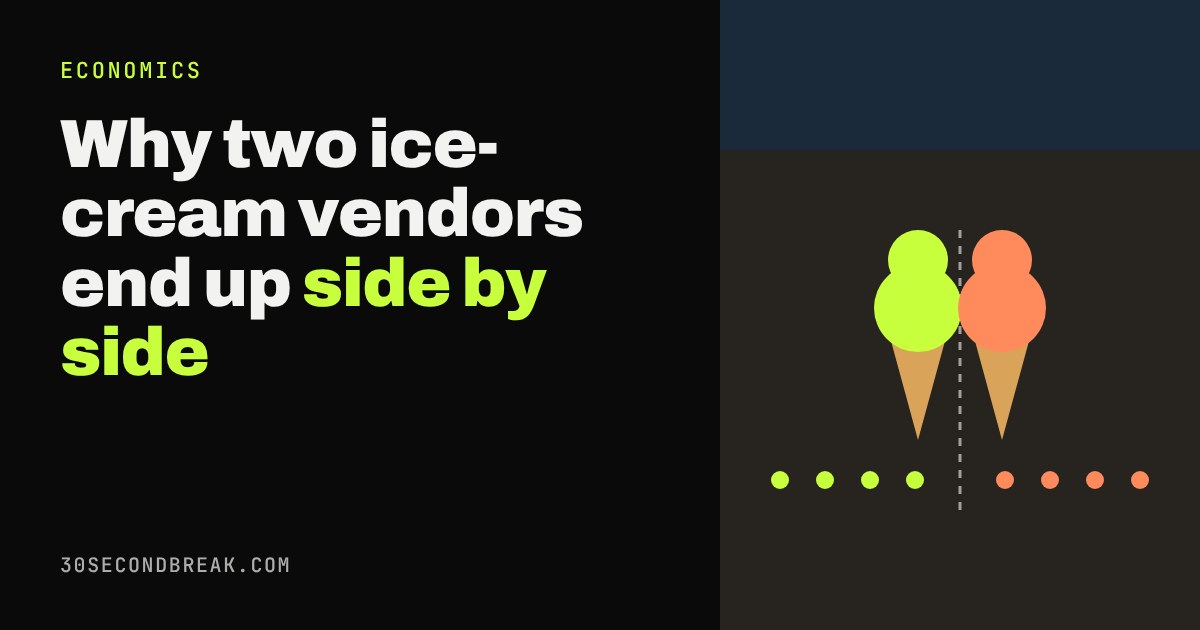
Two ice-cream vendors share a long beach, and every swimmer walks to the nearer cart. Where should each one park? Drag the carts and watch the dividing line shift: any step toward the middle steals customers from your rival, so both vendors end up side by side at the centre.
The twist is that the swimmers pay for it. At the centre the average walk is 100 m; at the quarter-points it would be 50 m, with the vendors earning exactly the same. This is Hotelling's 1929 "linear city", and the reason rival shops, petrol stations and even political parties bunch together.
Deep dive · 4 min
More in Economics
View all →
Why a free shortcut can make everyone's commute longer: Braess's paradox
Build a brand-new road and every commute gets longer. In a town of 4,000 drivers, two routes each take 65 minutes. Add a free shortcut and each driver…
Why the auction winner so often overpays: the winner's curse
Why does the winner of an auction so often go home poorer? When a prize is worth the same to everyone, each bidder only has a noisy estimate, and winning means…
Why mild preferences can build a segregated town: Schelling's chequerboard
Nobody in this town wants it split into blue and orange districts. Each household only asks that a few of its neighbours look like it. Yet run the rule and the…
Why good used cars vanish from the market: Akerlof's lemons
Why can a market of willing buyers and sellers fall apart? In 1970 the economist George Akerlof showed that when only the seller knows a used car's quality…
Why rival ice-cream carts end up side by side: Hotelling's beach
Put two ice-cream carts on a long beach and each one is tempted to creep toward the other, because standing next to a rival steals customers without losing…
Why adding a road can slow every driver down: Braess's paradox
You would think a free shortcut can only help. In 1968 the mathematician Dietrich Braess showed it can make every driver slower. In our four-road example…