Why the Moon always shows us the same face: tidal locking
30seconds
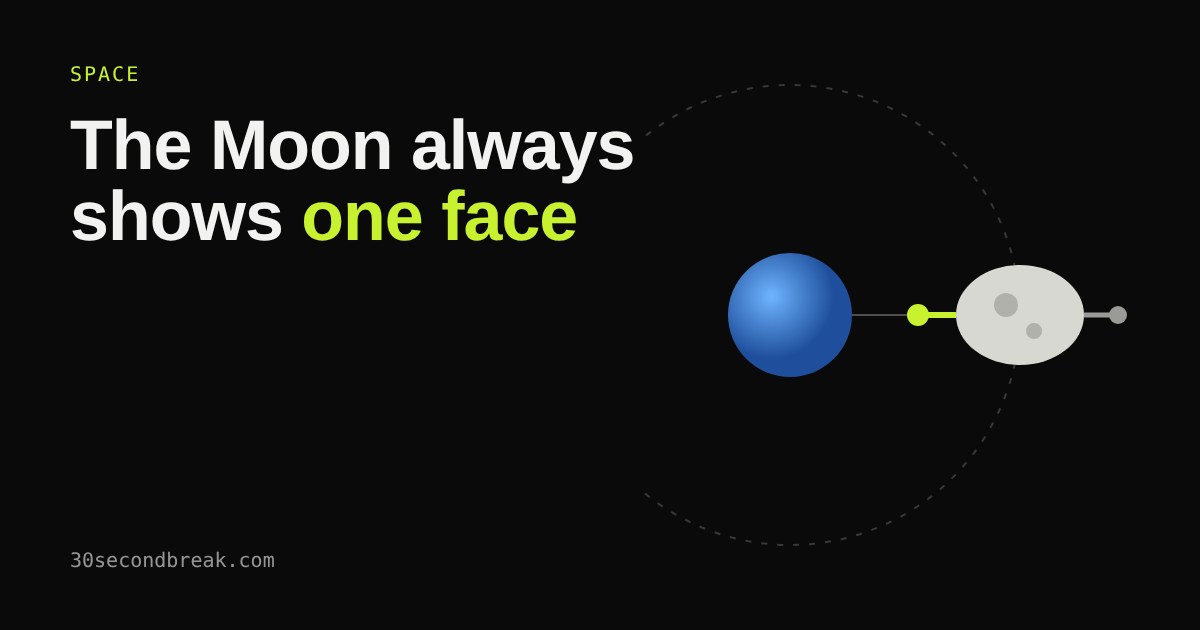
The Moon does spin. It turns exactly once for every trip around the Earth, so the same face always points our way. Walk around a chair while always facing it and you turn a full circle too.
Earth's gravity stretched the young Moon into a lemon shape, and friction in that stretched rock slowed its spin until the long axis locked onto Earth. Spin it fast below and let tides settle it.
Deep dive · 3 min
More in Earth & Space
View all →
Why stars twinkle and planets don't: one ray of light versus a whole disk
Stars twinkle because their light crosses pockets of warm and cool air that bend it a little, and a star is so far away that all its light takes the same path…
Why the night sky is dark: Olbers' paradox and the light that hasn't arrived yet
Go outside and look between the stars: it's dark. That's strange. In an endless, unchanging universe, every line of sight would end on a star, and the whole…
How astronomers find planets by their shadow: the dip in starlight
Most planets around other stars are far too faint to see directly, so astronomers watch the star instead. When a planet crosses its face, a tiny dark disc…
Why there are two high tides a day: the Moon pulls the near sea harder and the far sea softer
The sea rises twice a day, not once, and the second high tide happens on the side of the Earth facing away from the Moon. Why? The Moon pulls the near ocean a…
Why the Moon changes shape: always half lit, and only part of it faces you
Ask why the Moon changes shape and most people blame the Earth's shadow. It is a natural guess, and it is wrong: the Moon is half lit by the Sun all the time…
Why planets speed up near the Sun: Kepler's equal-areas law
Earth moves at 30.29 km/s near 3 January and 29.29 km/s near 4 July, with nothing pushing it along. The rule behind the change is Kepler's equal-areas law: a…