Why Russians have two blues: how a colour word can speed up your eyes
30seconds
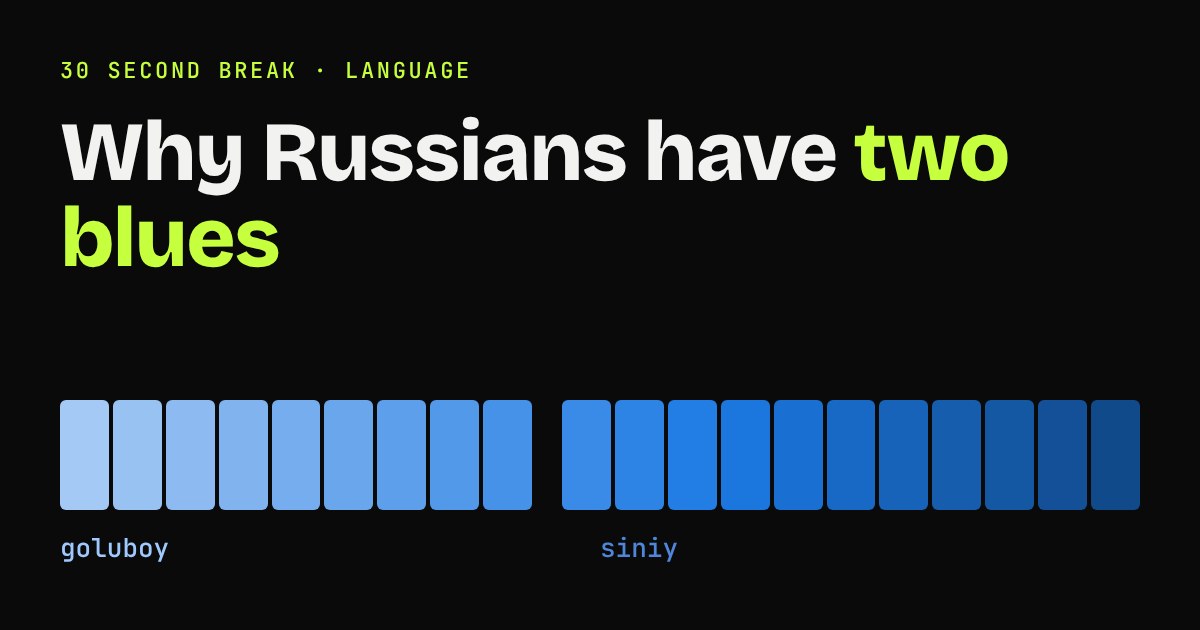
Russian has two basic words for blue, goluboy (light) and siniy (dark), and in a 2007 experiment Russian speakers were about 124 milliseconds faster at telling two close blues apart when they fell on opposite sides of that word border. English speakers showed no such gain, and a task that kept the verbal mind busy made the Russian advantage disappear.
Try the idea yourself: move the border across twenty equal steps of blue, then run a mini version of the matching test.
Deep dive · 4 min
More in Language
View all →
Why a sentence can nest forever on paper but not in your head: centre-embedding
The rat the cat the dog chased killed ate the malt. It is perfectly grammatical, and almost nobody can read it. English lets you tuck one clause inside another…
Why 'The old man the boat' stops you cold: garden-path sentences and a brain that guesses
Read "The old man the boat." and your brain probably crashes at the fifth word. It guessed "the old man" was one person and waited for a verb that never came…
Why Latin p became English f: Grimm's law and the sound-shift chain
Latin says pes, English says foot. Latin tres, English three. Latin cornu, English horn. The swap is not random: when the Germanic languages split off, their…
Why English plurals say s, z or iz: the wug test
Say 'cats' and 'dogs' out loud and listen to the last sound. One is a hiss, the other a buzz, and 'buses' adds a whole extra syllable. English spells all three…
Why the most common word is twice as common as the next: Zipf's law
Sort every word in a book from most to least common and a pattern appears: the top word is about twice as common as the second, three times as common as the…
Why “The old man the boat” reads as broken: garden-path sentences
Read this: The old man the boat. If it stalled you at the end, your brain did exactly what it always does: it guessed ahead and lost the bet. A garden-path…