Why a gene can vanish by pure luck: genetic drift
30seconds
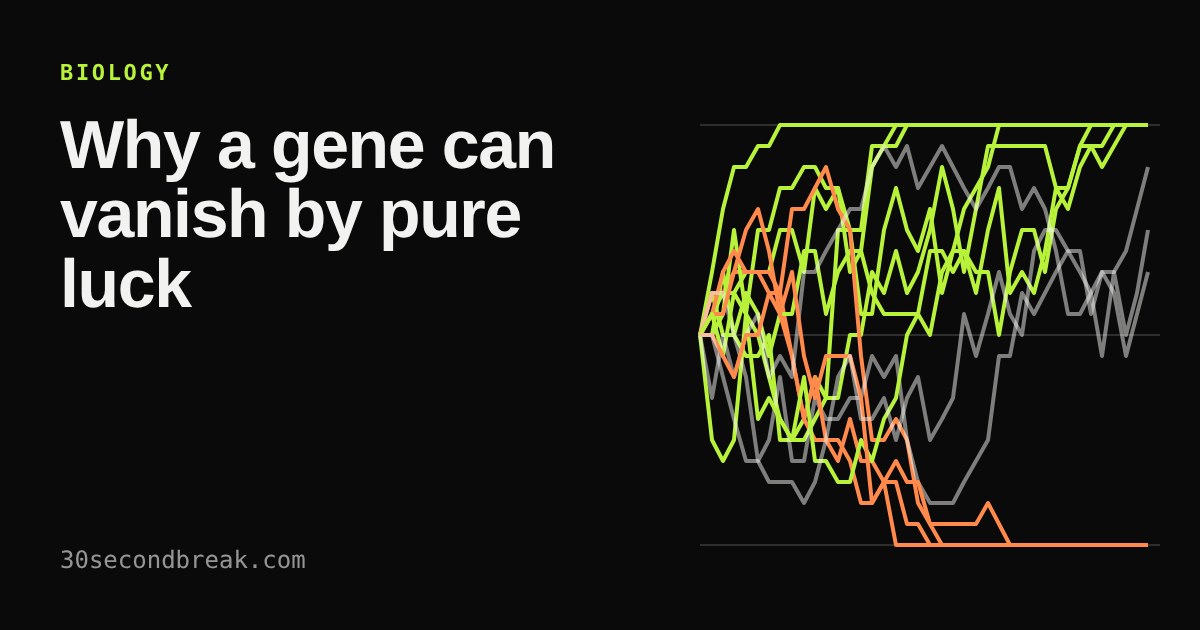
Two versions of a gene start at 50% each. Neither is better, yet in a small population one will vanish by pure chance and the other will take over. This is genetic drift: each generation is a random sample of the last, and a small sample rarely mirrors it.
Run twenty populations at once, shrink or grow them, and change the starting share to see how population size decides who gets stuck, from fruit flies in bottles to an island that remembers one storm.
Deep dive · 5 min
More in Biology
View all →
Why nearly every species makes sons and daughters in equal numbers: Fisher's grandchildren argument
Boys and girls are born in nearly equal numbers, about 105 boys for every 100 girls worldwide, even though one male could father far more children than one…
Why an elephant doesn't eat 200,000 times more than a mouse: Kleiber's three-quarter law
A mouse is 200,000 times lighter than an elephant, yet the elephant burns only about 9,000 times more energy. In 1932 Max Kleiber found that resting metabolic…
Why a nerve spike is always the same size: the all-or-nothing action potential
Every nerve signal in your body is the same size. A feather touch and a hammer blow send identical electrical spikes, so how does the brain tell them apart?…
Why predators boom after the prey do: Lotka–Volterra and the Adriatic fish puzzle
After the First World War, an Italian biologist noticed something odd in Adriatic fish catches: with less fishing, the share of predators had gone up, not…
Why a smooth embryo grows spots and stripes: Turing's two-chemical patterns
A leopard's spots and a zebra's stripes start from a smooth, featureless ball of cells. In 1952 Alan Turing showed how two chemicals that spread at different…
Why cells stay tiny: skin grows with the square, the cell with the cube
Double a cell's width and its skin grows 4 times, but the cytoplasm it must feed grows 8 times. Add diffusion, where time grows with the square of the…