Why a falling pole can be held up: feedback, and the PID controller
30seconds
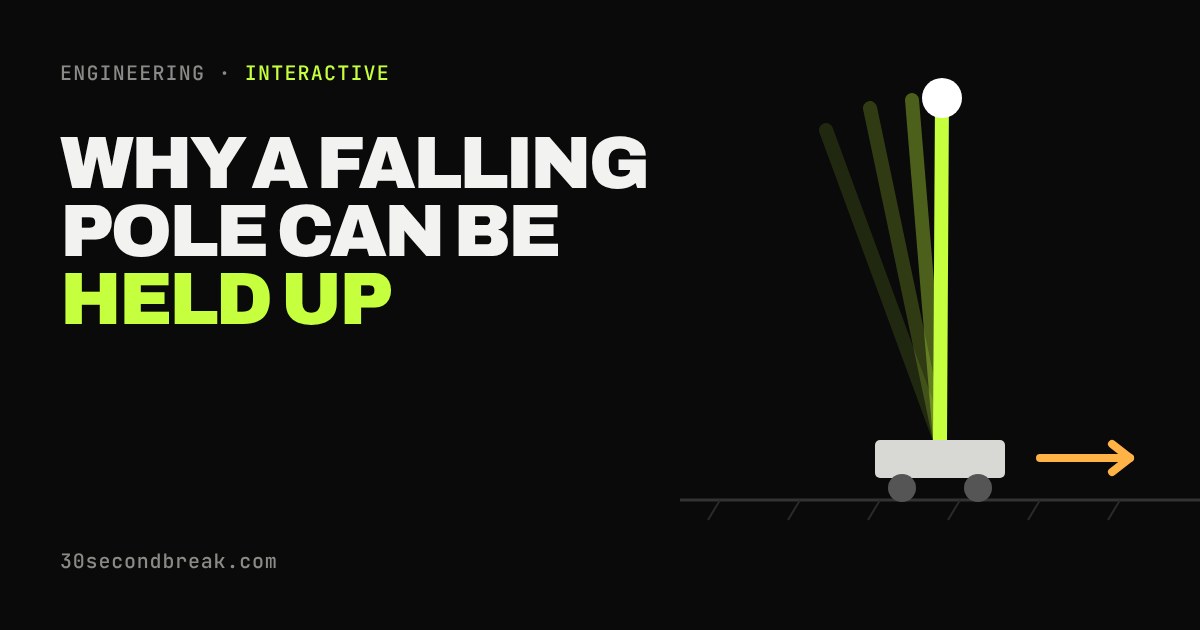
A pole on a cart wants to fall, and a controller that watches the lean and shoves the cart can hold it up. But how hard it pushes matters: too weak and it topples, P only and it wobbles forever, and adding a term that reacts to tipping speed makes the wobble die out.
Drag the pole, tune the two gains yourself, and meet the PID idea that Nicolas Minorsky wrote down while testing automatic steering on a battleship in 1922.
Deep dive · 4 min
More in Engineering
View all →
Why a low gear climbs hills: gear ratios trade speed for force
Pedal up a steep hill in the same gear you use on the flat and the pedals feel like concrete. Click to an easy gear and the climb gets bearable, but your feet…
Why a ship rolls back upright, until the cargo goes too high: the metacentre and the righting arm
A loaded ship that leans over usually rolls back upright, because the water's upward push shifts sideways and twists her straight. But raise the cargo high…
Why a dam is fat at the bottom: water's push grows with depth squared, its tipping with depth cubed
A dam is fat at the bottom and slim at the top because water pressure grows with depth, so the push grows with depth squared and the tipping effect with depth…
Why bridges are made of triangles: a square folds, a triangle cannot
A square made of four pinned rods folds flat at the slightest push, but a triangle of three rods cannot change shape at all. That one fact is why bridges…
Why Taipei 101 hangs a 660-tonne ball in its upper floors: the tuned mass damper
At the top of Taipei 101 a 660-tonne steel ball hangs in plain view. It is not decoration: it is a tuned mass damper that swings against the building and can…
Why airliner windows have no corners: stress piles up at the tightest curve
Cut a hole in a stretched plate and the force has to squeeze past it, so the metal beside the hole carries far more stress than the rest. For a round hole in a…