Why a letter you can see becomes unreadable in a crowd: visual crowding and Bouma's half-the-distance rule
30seconds
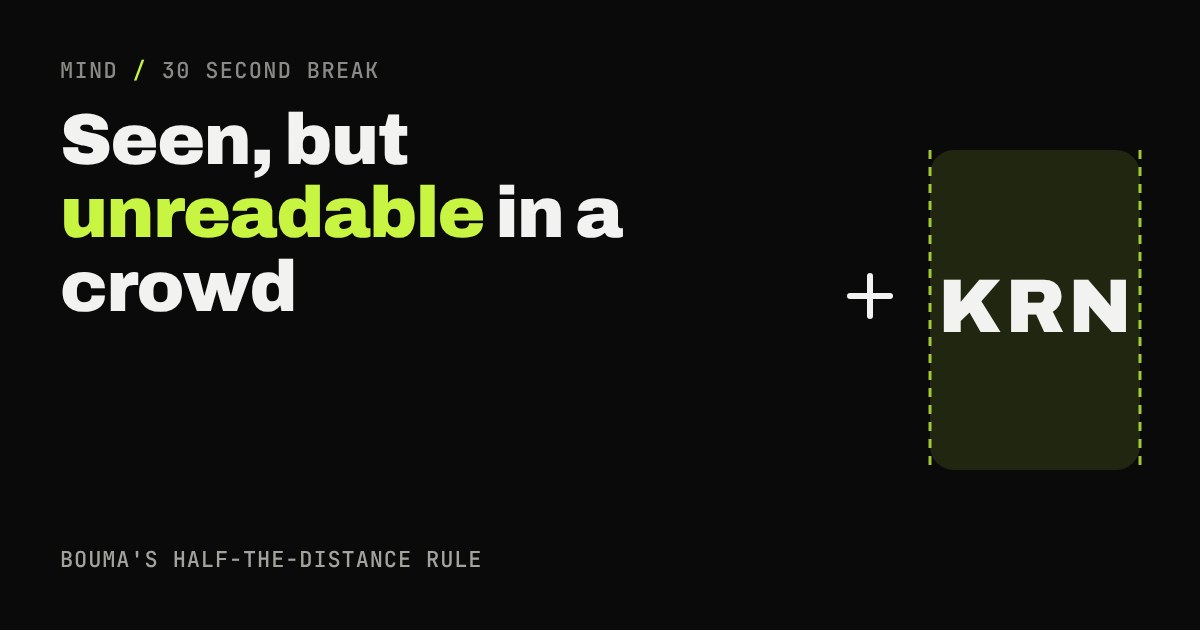
Fix your eyes on one spot and a letter off to the side is easy to see but impossible to read once its neighbours crowd in. This is crowding, and it follows a surprisingly tidy rule: Herman Bouma found in 1970 that a letter stays readable only if nothing else sits within roughly half its distance from where you are looking.
Drag a row of letters away from the fixation point, squeeze the gap, and watch the middle one dissolve. Making the letters bigger does not help, because crowding depends on spacing, not size.
Deep dive · 4 min
More in Mind
View all →
Why a number you know is useless still drags your guess: the anchoring effect
Spin a wheel that is rigged to stop on 10 or on 65, and people's guesses at the share of African countries in the UN swing from about 25% to about 45%. The…
Why the same circle looks smaller among big ones: the Ebbinghaus illusion and size contrast
Two identical orange circles, one ringed by big circles and one by small ones, and your eyes insist they differ. That is the Ebbinghaus illusion: your visual…
Why real coin flips look fake: streaks and the way we imagine randomness
Ask people to write down 100 random coin flips and they almost never include a streak of six, yet a real coin makes one about four times in five. Our gut…
Why still rocks creep upward after you stare at a waterfall: the motion aftereffect
Stare at a waterfall, then look at the rocks beside it, and they seem to crawl upward. They go nowhere, yet they move. This is the motion aftereffect, noticed…
Why you stumble naming the ink of a clashing colour word: the Stroop effect
Name the ink colour of the word GREEN printed in red and you stumble, even though the rule is trivial. In 1935 John Ridley Stroop timed it: naming the ink of…
Why a dot vanishes when you look away from it: the blind spot where the optic nerve exits
Close one eye, stare at a cross, and a dot a hand's width away simply vanishes. That is your blind spot: the place where the optic nerve leaves each eye, with…