Why bread rises: yeast only inflates the bubbles your kneading put there
30seconds
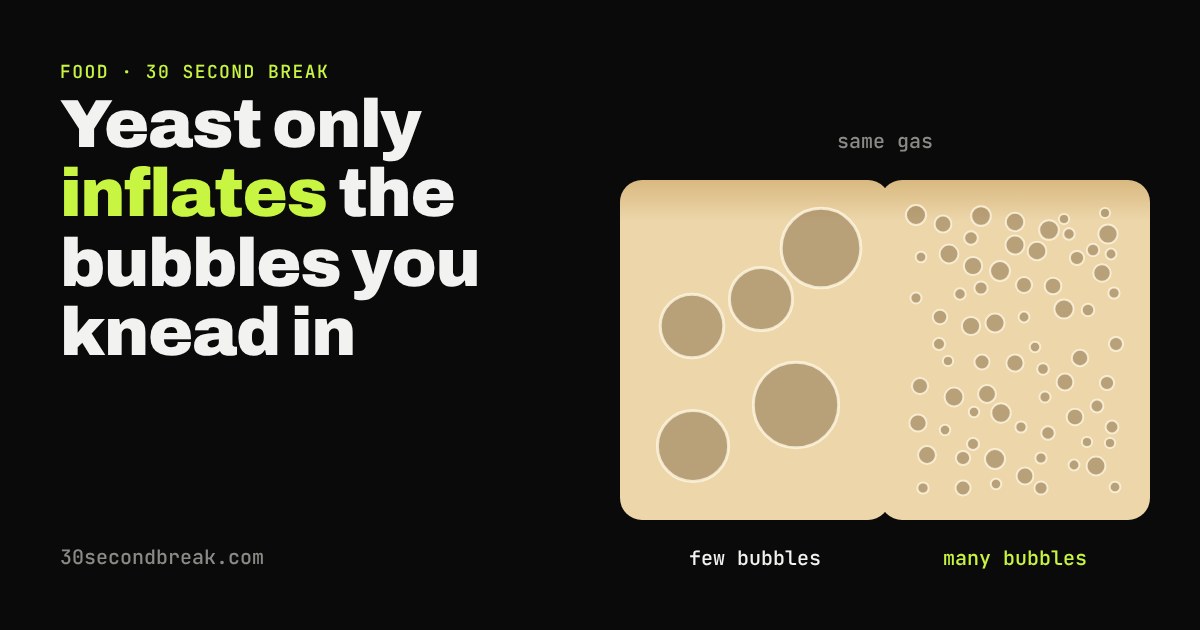
Yeast doesn't blow bubbles into dough. It only inflates the ones your kneading already folded in.
That means the number of bubbles is fixed early, and the yeast just decides how big each gets: the same gas shared between a few bubbles makes tunnels, shared between thousands makes a fine crumb.
Knead a virtual dough, proof it at different temperatures and bake it to see why a rise isn't the same as a good loaf.
Deep dive · 4 min
More in Food Science
View all →
Why popcorn pops: a sealed kernel, trapped steam and a 180 °C tipping point
A popcorn kernel is a seed with a sealed hull and a little water inside. Heat it and the water can't boil away, so steam pressure builds, like a tiny pressure…
Why salt makes ice cream freeze: ice melting below 0 °C pulls out the heat
Ice is already at 0 °C, so how can a handful of rock salt make it colder? Because salt makes ice want to melt below 0 °C, and melting costs energy: about 334…
Why chocolate needs tempering: cocoa butter can freeze six ways, and only one snaps
Two bars of dark chocolate can share every ingredient and still differ completely: one glossy, snappy and firm, the other dull and crumbly. The secret is cocoa…
Why a wet steak won't brown: boiling water caps the surface at 100 °C
Put a wet steak in a hot pan and it goes grey and steams. Pat it dry and it forms a dark, savoury crust. The pan is equally hot both times. The difference is a…
Why oil and water mix in mayonnaise: an egg yolk coats every droplet
Oil and water refuse to mix, yet mayonnaise is about two-thirds to four-fifths oil and holds its shape on a spoon. One egg yolk does the work: its molecules…
Why popcorn pops: a pea-sized pressure cooker that gives way at 180 °C
A popcorn kernel is a pressure cooker the size of a pea. Its tough hull seals in about 14% water, so as the pan heats, the water cannot boil away and the…