Why sand on a vibrating plate draws pictures: Chladni figures
30seconds
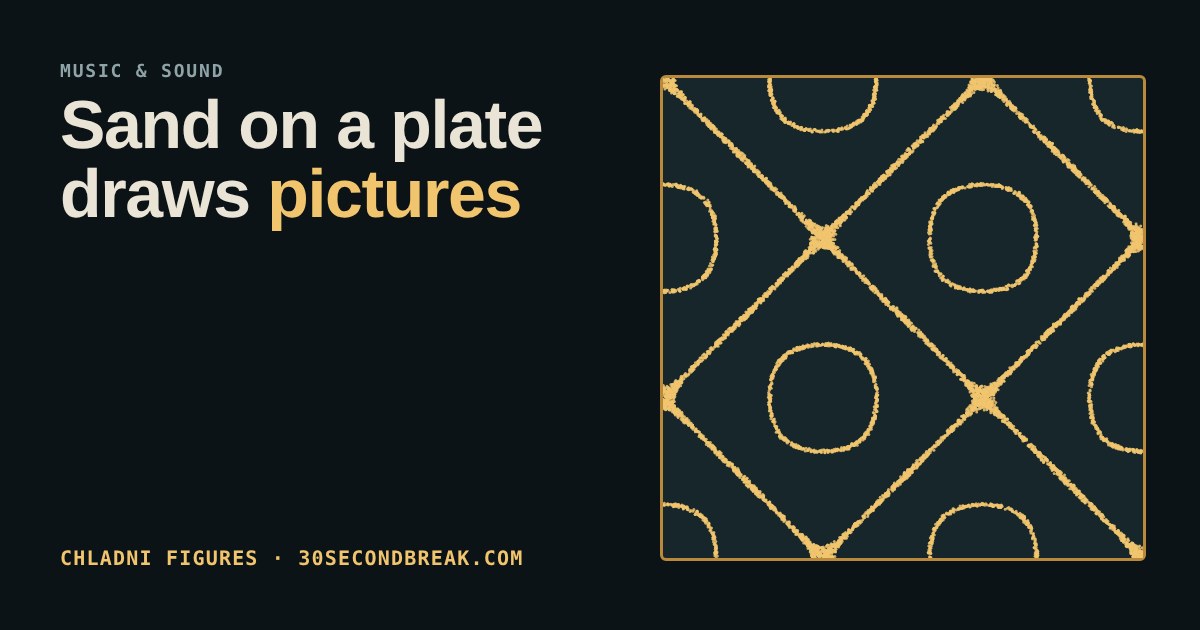
Sprinkle sand on a thin metal plate, draw a violin bow along its edge, and the sand leaps into sharp, symmetrical lines. Change the pitch and the picture changes.
The sand maps where the plate refuses to move. Grains get thrown off the shaking patches and collect on the still lines between them. In 1787 Ernst Chladni showed these figures, and Napoleon later set a prize for explaining them. Drag across a simulated plate to find the pitches where it rings.
More in Music & Sound
View all →
Why a tone can climb forever without getting higher: the Shepard illusion
Play a tone that climbs and climbs, forever, and never gets any higher. It sounds impossible, but it only takes a few sine waves and one volume curve. A…
Why you hear bass from a speaker too small to make it: the missing fundamental
Your phone speaker is far too small to produce a deep bass note, yet you still hear the bass. The trick is that pitch is not a frequency in the air. It is a…
Why guitar frets get closer together as you go up the neck
Guitar frets crowd together toward the body because of one fact about hearing: we hear pitch by ratio, not by difference. Each fret has to raise the note by…
Why some notes sound sweet together and others seem to fight
Play C and E together and they sound sweet. Play C and C sharp and they buzz. The notes aren't the problem: the clash only happens when they meet. Every…
Why two almost-in-tune notes throb, and how tuners use the wobble
Play two notes that are almost in tune and you hear one note that swells and fades: wah-wah-wah. Neither string is wobbling. The throb, called a beat, appears…
Why a piano has 12 notes: the circle of fifths that never quite closes
Stack pure 3:2 fifths, the most consonant interval after the octave, and you'd expect to eventually land back on your starting note. You never do. After twelve…