Why 'The old man the boat' stops you cold: garden-path sentences and a brain that guesses
30seconds
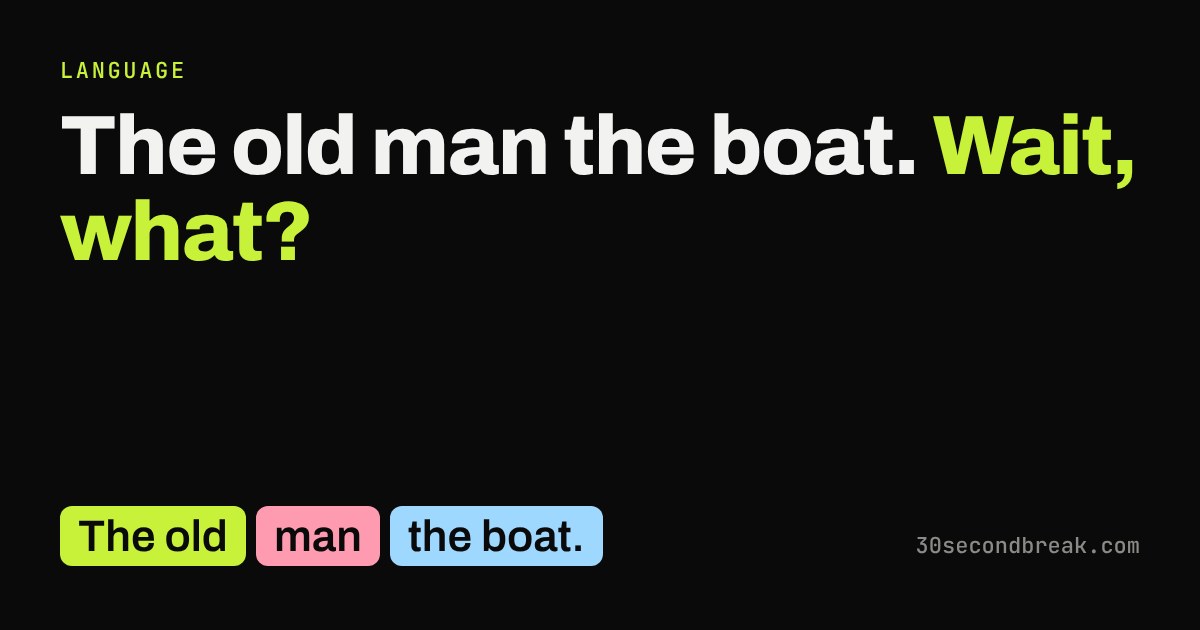
Read "The old man the boat." and your brain probably crashes at the fifth word. It guessed "the old man" was one person and waited for a verb that never came. The sentence is fine: the old are the people, and they man the boat.
This is a garden-path sentence. Step through three of them one word at a time and watch the structure your brain builds, and then has to break. Then see why, in one experiment, readers often still believed Anna dressed the baby after they had fixed the grammar.
More in Language
View all →
Why a language gets grammar when nobody designs it: the iterated-learning experiment
How does a language get grammar when nobody designs it? In a 2008 experiment, volunteers learned an alien language of 27 random words for pictures, saw only 14…
How babies find words in a stream of sound: transitional probabilities
Babies hear speech as one unbroken smear, with no gaps between words, yet somehow they start picking out words long before they can say one. One clue sits in…
Why Russians have two blues: how a colour word can speed up your eyes
Russian has two basic words for blue, goluboy (light) and siniy (dark), and in a 2007 experiment Russian speakers were about 124 milliseconds faster at telling…
Why a sentence can nest forever on paper but not in your head: centre-embedding
The rat the cat the dog chased killed ate the malt. It is perfectly grammatical, and almost nobody can read it. English lets you tuck one clause inside another…
Why Latin p became English f: Grimm's law and the sound-shift chain
Latin says pes, English says foot. Latin tres, English three. Latin cornu, English horn. The swap is not random: when the Germanic languages split off, their…
Why English plurals say s, z or iz: the wug test
Say 'cats' and 'dogs' out loud and listen to the last sound. One is a hiss, the other a buzz, and 'buses' adds a whole extra syllable. English spells all three…